
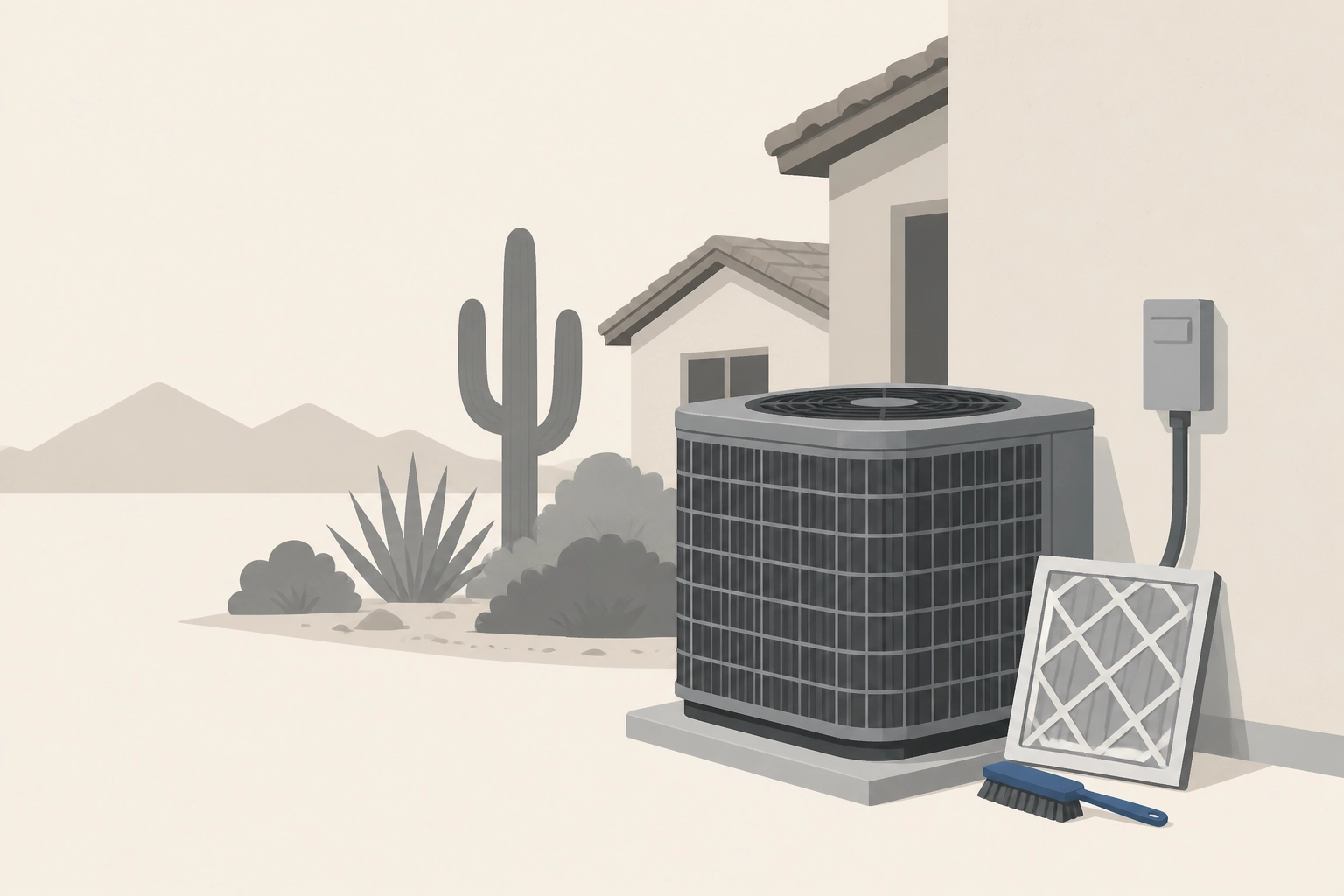
Living in Mesa, Arizona means dealing with some of the most intense heat in the country. When summer temperatures regularly climb past 110 degrees, your air conditioner is not just a luxury; it is an absolute necessity. The last thing any homeowner wants is a system breakdown in the middle of July with no relief in sight.
That is exactly why ac maintenance mesa az homeowners prioritize is so important to understand. Regular upkeep keeps your system running efficiently, extends its lifespan, and helps you avoid costly emergency repairs that always seem to happen at the worst possible time.
But if you are new to homeownership or simply have never thought much about HVAC care, you might have questions. What does AC maintenance actually involve? How much should you expect to pay? And is it really worth scheduling year after year?
This guide breaks it all down in simple, straightforward terms. You will learn what a standard maintenance visit includes, what it typically costs in the Mesa area, and why skipping it can end up costing you far more in the long run.
Why AC Maintenance Is More Critical in Mesa Than Almost Anywhere Else
If you live in Mesa, you already know that summer heat is not a seasonal inconvenience. It is a months-long endurance test. The Phoenix metro regularly sees summer highs between 110 and 115 degrees Fahrenheit, and at those temperatures, a failed air conditioner becomes a genuine medical emergency within hours. This is not an exaggeration. Heat-related illness and death are documented risks in Maricopa County every single summer, which is why your HVAC system here carries a level of responsibility it simply does not carry in most other parts of the country.
Arizona's climate also means your system never really gets a break. While homeowners in Ohio or Virginia get several months of mild weather where their AC sits idle, Mesa systems run in cooling mode for the overwhelming majority of the year. That relentless operating schedule accelerates wear on critical components like capacitors, contactors, and coil fins far faster than the national average. As research into desert HVAC maintenance confirms, even small problems escalate quickly when a system runs under constant extreme load.
Then comes monsoon season. Dense haboobs coat condenser coils with fine particulate dust, clog filters rapidly, and introduce elevated humidity that forces an already-stressed system to work even harder. The unique ways Arizona's desert environment damages HVAC equipment are well documented, combining UV exposure, thermal cycling, and dust infiltration into a threat profile that does not exist in most U.S. markets.
Add to this the Phoenix metro's explosive construction growth and a nationally projected HVAC technician shortage, with Arizona forecasting 18% HVAC employment growth through 2034, and the picture becomes clear. Homeowners who skip maintenance risk sitting at the bottom of a very long service queue on the hottest day of the year.
What Is Included in a Professional AC Maintenance Visit
A professional AC maintenance visit in Mesa covers significantly more ground than a basic filter swap. Given that Valley systems run nearly year-round under extreme conditions, a thorough tune-up addresses mechanical, electrical, and environmental factors that simply do not exist in milder climates. Here is exactly what a qualified technician should be doing when they show up at your door.
1. Condenser Coil Cleaning
The outdoor unit sits exposed to blowing dust, pollen, and monsoon debris for every month of the year. Over time, that material coats the condenser coils and creates an insulating layer that blocks heat transfer. When the coils cannot release heat efficiently, the compressor compensates by running longer cycles, consuming more electricity and wearing down faster. A thorough coil cleaning restores the heat exchange process and is one of the highest-impact tasks in any maintenance visit.
2. Refrigerant Level Check
Low refrigerant is a slow, invisible problem. A system running with insufficient charge still cools, just poorly, and the compressor works harder to compensate. Over weeks and months, that extra strain leads to premature failure. A technician will measure charge levels precisely and inspect the refrigerant lines for any leaks that may be quietly degrading performance. According to Carrier's AC maintenance guide, proper refrigerant charge is a foundational element of system efficiency and longevity.
3. Air Filter Inspection and Replacement
In Mesa's dusty environment, a filter that would last 90 days in most cities may reach maximum load in 30 to 45 days. A clogged filter restricts airflow across the evaporator coil, forces the blower motor to work harder, and drives up your energy bill. Your technician should inspect the filter at every visit and replace it if there is any doubt about its condition.
4. Capacitor and Contactor Inspection
Capacitors and contactors are small electrical components that take enormous punishment under sustained heat stress. A capacitor starts and keeps the motors running; a contactor controls the high-voltage connection to the compressor and fan. Both tend to degrade gradually before failing completely. Catching a weakening capacitor during a spring maintenance visit costs far less than an emergency service call on a 112-degree afternoon in late July.
5. Ductwork Inspection for Leaks and Debris
Fine desert particulate accumulates inside ductwork over time, and even small leaks allow conditioned air to escape into unconditioned attic space. In a home running cooling for nine or more months annually, duct leaks can reduce system efficiency by 20 to 30 percent. A technician should visually inspect accessible duct connections, check for gaps at registers and joints, and flag any sections that warrant closer attention or sealing.
6. Smart Thermostat Calibration Check
For homeowners using programmable or Wi-Fi thermostats, a maintenance visit is the right time to verify that sensors are reading accurately, firmware is current, and schedules are set to match current household patterns. An uncalibrated thermostat can cause the system to short-cycle or run longer than necessary, both of which add cost. This step is especially relevant as smart home integration becomes a standard part of maintenance offerings in 2026.
7. Post-Monsoon Prep Inspection
Mesa's monsoon season introduces a maintenance trigger that most homeowners overlook. Storms push moisture, organic debris, and fine grit directly into outdoor unit cabinets. After monsoon season, a qualified technician should visually inspect the unit for debris intrusion, check electrical connections for corrosion from moisture exposure, and clear any material that has accumulated inside or around the cabinet. This inspection, ideally scheduled in September or October, serves as a valuable second annual service window beyond the standard pre-summer visit.
When Should Mesa Homeowners Schedule AC Maintenance
Timing is everything when it comes to AC maintenance in Mesa. The optimal window for scheduling your annual tune-up is late February through March. Booking during this period gives your technician enough runway to identify problems, order any necessary parts, and complete follow-up work before outdoor temperatures push past 90 degrees Fahrenheit in April and May. Once summer heat arrives, your system will be running 12 to 16 hours per day, and that is not the time to discover a weakening capacitor or low refrigerant charge.
Scheduling early also protects your access to preferred appointment slots. Once temperatures spike across the East Valley, HVAC contractors fill their calendars fast and emergency calls jump to the front of the line. A homeowner who waits until June is competing with everyone else who also waited, and routine maintenance slots disappear quickly. Booking in late winter locks in your preferred time and often costs significantly less than an emergency dispatch during peak season.
A second maintenance visit in September or October is equally important for Mesa homes. Arizona's monsoon season runs from mid-June through late September, and the storms that roll through the Valley leave behind coil debris, moisture-driven electrical corrosion, and clogged condensate drain lines. A post-monsoon inspection catches this damage before it compounds over winter. You can review a detailed HVAC maintenance checklist for Mesa AZ homeowners to understand exactly what technicians look for during each seasonal visit.
Finally, if you recently moved into a newly built Mesa home, do not assume the system is ready to perform. Builder-installed units frequently accumulate construction dust in ductwork and are often never properly commissioned to manufacturer specifications. Scheduling a professional inspection before your first full cooling season is a straightforward step that can prevent costly problems down the road.
What Happens If You Skip Annual AC Maintenance in Mesa
Skipping your annual AC tune-up in Mesa carries consequences that go well beyond a warm afternoon indoors. The five risks below represent real financial and safety exposure for homeowners in this climate.
1. Compressor Burnout The compressor is the most expensive component in your system, and it is also the most vulnerable when maintenance is deferred. A compressor operating with dirty coils, low refrigerant, or a worn capacitor works significantly harder than it should, especially when outdoor temperatures routinely push past 110 degrees. That sustained stress leads to premature failure, and residential compressor replacement typically costs between $1,500 and $2,500. Catching the warning signs early during a routine visit is far less costly than an emergency replacement in July.
2. Undetected Refrigerant Leaks A slow refrigerant leak caught at a spring maintenance visit is a minor repair. The same leak left undetected for an entire Mesa cooling season compounds into a serious problem. As refrigerant levels drop, the system runs continuously without reaching your set temperature. In a worst-case scenario, indoor temperatures can climb past 90 degrees Fahrenheit, a genuine health hazard given the heat conditions outside. Understanding what can happen when AC maintenance is skipped reinforces why catching leaks early is essential.
3. Shortened System Lifespan Well-maintained AC systems in Arizona typically last 12 to 15 years. Neglected systems in the same demanding climate often require full replacement in 8 to 10 years. That gap represents $4,000 to $8,000 or more in equipment costs that proper maintenance could have deferred.
4. Rising Replacement Costs in 2026 Trade tariff pressures on HVAC components have pushed equipment prices higher in 2025 and 2026. Extending the life of your existing system through annual maintenance is a stronger financial argument right now than it has been in recent years. Every additional season you get from a well-maintained unit is money kept in your pocket as replacement costs continue climbing.
5. Deteriorating Indoor Air Quality Overloaded filters and coil buildup circulate dust, mold spores, and allergens through your home. For Mesa families with allergy sufferers or young children, this concern intensifies during monsoon season, when dust storms send airborne particulate levels spiking. The consequences of skipping HVAC maintenance consistently identify air quality degradation as one of the most underestimated risks of deferred care.
AC Maintenance Plan vs. One-Time Visit: Which Is Right for You
Deciding between a one-time visit and an ongoing maintenance plan comes down to where you are in your homeownership journey and how long you plan to stay in your Mesa property.
A one-time maintenance visit is the right starting point if you have recently purchased a home and want a professional to assess the existing equipment before committing to a longer service relationship. Think of it as a baseline inspection that tells you exactly what condition the system is in, what deferred work might be coming, and whether the equipment was properly installed and maintained by previous owners.
For most Mesa homeowners, a semi-annual or annual maintenance plan delivers significantly better value over a three to five year horizon. Plans typically include discounted per-visit rates, priority scheduling during peak season, and reduced diagnostic fees on any repair calls that come up between visits. Members also receive 10 to 20 percent discounts on parts and labor, which adds up quickly when you factor in Mesa's demanding operating environment.
Warranty protection is a compelling reason for owners of newer or higher-end systems. Many manufacturer warranties require documented annual maintenance performed by a licensed technician to remain valid. Without that paper trail, a costly component failure could fall outside warranty coverage entirely, leaving you responsible for the full repair bill.
Semi-annual plans aligned with the late-February and October service windows provide the broadest protection in a climate that stresses systems through extreme summer heat and monsoon season humidity and dust. One visit prepares your system for peak summer load; the second addresses anything the monsoon season introduced.
Cost predictability is perhaps the strongest argument for plan enrollment. Emergency repair calls during peak season carry after-hours diagnostic fees that can exceed $150 to $250 before a single part is ordered. A maintenance plan removes that financial uncertainty and gives you priority access to a technician when everyone in the Valley needs one at the same time.
How Much Does AC Maintenance Cost in Mesa, AZ
For a single-system home in Mesa, a standard one-time professional AC tune-up typically runs $89 to $150, depending on the contractor, the scope of the visit, and whether refrigerant pressure testing is included. Some promotional offers advertise visits as low as $49 to $79, but those prices generally reflect a shorter, checklist-only inspection rather than the measurement-based work your system actually needs. A legitimate tune-up should include recorded refrigerant pressures, capacitor microfarad readings, temperature split measurements, and amp draw checks on both the compressor and fan motors.
If you are evaluating a maintenance plan, expect to pay $150 to $300 per year for single-system coverage. Plans at the higher end of that range typically include two visits per year, priority scheduling during peak summer demand, and discounted rates on any repairs identified during the visit. For Mesa homeowners who plan to stay in their homes long-term, an annual plan delivers better value than booking one-time visits each spring.
When comparing quotes, look carefully at what is actually included. A $79 tune-up that skips coil cleaning or refrigerant testing is not the same service as a comprehensive $129 visit that covers both. The 2026 Mesa AC tune-up pricing breakdown from Fast Track Heating and Cooling illustrates this clearly: a $49 visit buys roughly 20 minutes of work, while a $149 visit delivers 60 to 90 minutes of measurement-based diagnostics.
The financial case for maintenance has never been stronger than it is in 2026. Tariff pressures on imported HVAC components are pushing replacement costs higher across the Phoenix metro, with full system replacements now commonly running $5,500 to $8,500 for a standard home. Against that backdrop, a $150 maintenance visit that catches a failing capacitor before it triggers a $2,000 compressor failure is straightforward math. That single catch more than pays for several years of annual tune-ups.
Gray Goat Air offers transparent maintenance pricing for Mesa homeowners, with options for both one-time visits and ongoing service plans. Contact the team directly for a quote matched to your specific system and home size.
Why Mesa Homeowners Choose Gray Goat Air for AC Maintenance
Mesa homeowners searching for reliable AC maintenance have real choices, and the decision matters more here than in most parts of the country. When temperatures climb past 110°F, who services your system is not a minor preference. It is a decision with direct consequences for your family's safety and your equipment's lifespan.
Gray Goat Air is a locally rooted Phoenix metro contractor, not a national franchise operating from a distant call center. That distinction shapes everything from how quickly a technician arrives to how service decisions get made. Local roots mean technicians who understand the East Valley's specific conditions, including monsoon dust loads, extreme cooling cycles, and the wear patterns unique to systems running nearly year-round in this climate.
The Gray Goat Air team services all major residential HVAC equipment types, including central air conditioners, heat pumps, and ductless mini-splits. For homeowners with upgraded or mixed systems, that single-provider capability eliminates the frustration of coordinating multiple contractors.
Heavy advertising budgets do not automatically translate to better service. Local contractors with established technician relationships and lower overhead frequently deliver more attentive, transparent work at competitive prices. Mesa homeowners asking neighbors for HVAC recommendations consistently prioritize trust and continuity over brand recognition, which reflects exactly the kind of relationship Gray Goat Air is built to provide.
The homeowners Gray Goat Air serves expect professional-grade work, clear pricing, and honest answers. A technician who explains findings without pushing unnecessary services is the standard, not the exception. Scheduling a pre-season maintenance visit remains the single most effective step you can take to protect your comfort and your investment before summer arrives.
Schedule Your Mesa AC Tune-Up Before the Heat Arrives
The window to act is now. Book your maintenance visit between late February and March to secure your preferred appointment time before peak season demand fills every available slot. By April, Mesa HVAC schedules tighten fast, and by June, same-day emergency calls take priority over routine tune-ups.
Before you schedule with any provider, use the checklist covered earlier in this post to confirm the visit includes coil cleaning, refrigerant inspection, capacitor testing, filter replacement, and ductwork review. A visit that skips any of these items is an incomplete tune-up, regardless of the price.
If your system is more than five years old or has no documented service history, treat this first visit as the foundation of an ongoing maintenance relationship rather than a one-time fix. Older systems need a diagnostic baseline before you can measure progress or catch developing problems early.
Contact Gray Goat Air to ask about maintenance plan options that include priority scheduling and reduced repair fees. Those two benefits alone cover the cost of the plan the first time you need urgent service on a 115°F July afternoon. A professional AC tune-up typically costs a fraction of an emergency repair call. In Mesa's climate, preventive maintenance is not optional. It is simply the smartest financial decision a homeowner can make.
Conclusion
Living in Mesa means your AC is not optional; it is essential. By now, you understand what a professional maintenance visit involves, what it realistically costs, and why skipping it can lead to expensive breakdowns during the hottest months of the year. You also know that consistent upkeep extends your system's lifespan and keeps energy bills from spiraling out of control.
The bottom line is simple: a small investment in annual maintenance protects a much larger investment in your home's comfort.
Do not wait until your system struggles or fails to take action. Schedule your AC maintenance appointment before summer arrives, when technicians are still available and you have time on your side. Find a trusted Mesa HVAC professional today, and head into the heat season with confidence knowing your system is ready to perform when you need it most.