
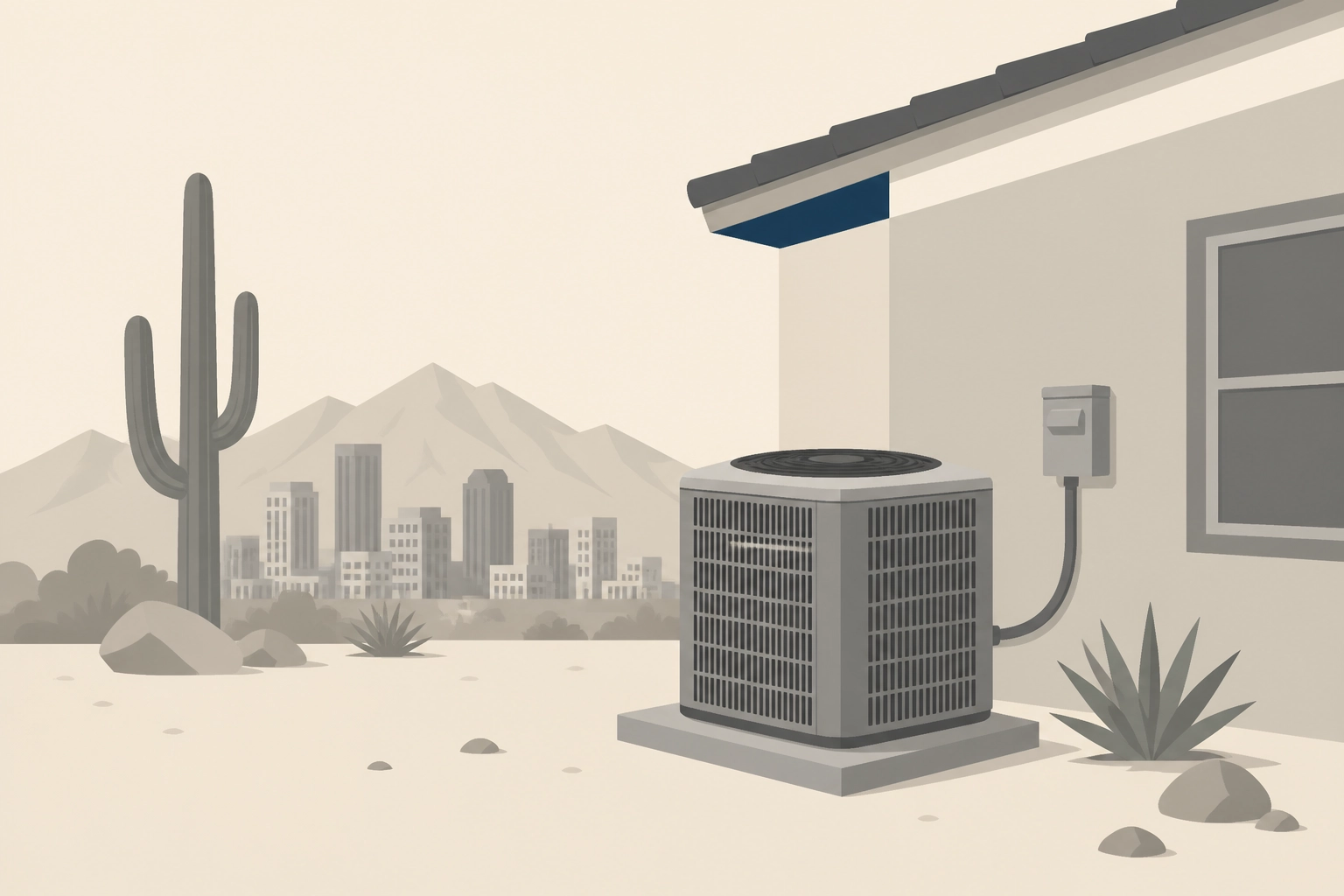
When Phoenix temperatures push past 110 degrees, a failing air conditioner is not just an inconvenience; it's a genuine health risk. If your system is struggling to keep up, making strange noises, or sending your energy bills through the roof, it may be time to have an honest conversation about AC replacement in Phoenix, AZ.
Replacing your air conditioner is a significant investment, and homeowners deserve clear, straightforward information before making that decision. Too many people either wait too long and face emergency situations, or they replace a system prematurely because they didn't know their options.
This guide cuts through the confusion. You'll learn the most common signs that your AC unit is beyond repair, what a realistic replacement costs in the Phoenix market, and what the actual installation process looks like from start to finish. Whether you're already dealing with a broken system or simply planning ahead for aging equipment, the information here will help you move forward with confidence and avoid costly mistakes. Let's break it all down.
Signs Your Phoenix AC Needs Replacement, Not Repair
Knowing when to stop repairing and start replacing your AC unit is one of the most financially consequential decisions a Phoenix homeowner will make. Because Arizona's extreme heat puts roughly 50% more operating hours on a system annually than moderate climates, the national repair-vs-replace rules need to be recalibrated for local conditions. Use these five signals to make a confident, informed call.
1. Apply the 50% Rule, Adjusted for Phoenix
The widely cited guideline holds that if a repair estimate exceeds 50% of the unit's remaining value, replacement delivers better long-term ROI. In Phoenix, experienced contractors often tighten that threshold to 40%, because a 10-year-old Arizona system has endured wear equivalent to a 15-year-old system in the Midwest. For units between 12 and 15 years old, most contractors recommend replacement unless the repair falls under $400 to $500. Once a system crosses the 15-year mark, replacement is almost always the financially sound path forward.
2. Check Your Refrigerant Type Immediately
If your system still runs on R-22 (Freon), the repair math rarely works in your favor. R-22 production was phased out in 2020, meaning a recharge alone now costs $600 to $1,500 with no guarantee of future supply. Parts availability continues to erode each year. Any significant repair on an R-22 system is, in practical terms, a down payment on a system you will replace within a few years anyway. According to a Phoenix-focused repair-vs-replace guide, R-22 dependency is one of the clearest signals that replacement is overdue.
3. Count Your Service Calls
One repair every few years falls within normal wear expectations. Two or more service calls within a single Phoenix summer, however, points toward systemic failure rather than isolated component issues. Once a system begins cascading failures, the pattern rarely reverses. After a compressor repair on a unit older than 10 years, the next failure is typically two to three years away, meaning you are paying repair costs while still on a countdown to full replacement.
4. Watch Your Utility Bills
Steadily rising electricity costs without any change in usage habits are a documented sign of compressor efficiency decline. Older systems rated SEER 10 or below cost significantly more to operate than modern high-efficiency equivalents. In Phoenix, where AC units run far longer daily cycles than in temperate markets, that efficiency gap compounds quickly across a billing season and across years. If your summer SRP or APS bills have been climbing consistently, your aging system is likely the primary cause.
5. Demand Transparency From Your Contractor
A trustworthy contractor will present both repair and replacement options with clear, itemized cost projections rather than defaulting to the higher-ticket recommendation. Understanding how to choose the right AC service provider in Phoenix is itself a critical step in this process. As outlined in authoritative Arizona repair-vs-replace guidance, a credible contractor slows the decision down rather than exploiting the urgency of a mid-summer failure. Request both quotes in writing, compare total projected costs over five years, and make the decision on data, not pressure.
How Long Do AC Units Actually Last in Phoenix?
Phoenix is simply harder on air conditioning equipment than almost anywhere else in the country. While the national average lifespan for a central AC unit falls between 15 and 20 years, Arizona units typically last just 10 to 15 years, and poorly maintained systems can fail in as few as 8 years. The gap exists for one straightforward reason: Phoenix systems work an extraordinary amount more than their counterparts in moderate climates.
Runtime Is the Real Culprit
A typical AC unit in a temperate climate might run 4 to 6 hours on a hot day. A Phoenix unit runs 12 to 16 hours daily from June through September, accumulating roughly 1,800 extra operating hours per year compared to the national average. That translates to a compressor working nearly twice as hard, processing heat through a brutal 40-degree differential, pushing against 115-degree outdoor temperatures to maintain a 75-degree interior. Compressor wear accelerates, capacitors fail earlier, and coil degradation sets in faster than any nameplate rating anticipates. The manufacturer's stated lifespan assumes average operating conditions. Phoenix is not average.
The 2008 to 2014 Risk Window
If your system was installed between 2008 and 2014, it is now 12 to 18 years old and sitting squarely inside the high-risk replacement window for Valley conditions. Systems in this age range deserve a professional evaluation before the next cooling season begins, not after your first 110-degree day reveals a failing compressor. Units installed before 2010 carry an additional concern: many still use R-22 refrigerant, which is no longer manufactured and has become extremely expensive to source for repairs.
Maintenance Helps, But Physics Wins
Annual tune-ups, monthly filter changes during peak season, and keeping condenser coils clear of monsoon debris all extend useful life, and all are worth doing. However, no maintenance program reverses cumulative mechanical fatigue. A 14- or 15-year-old Phoenix unit has fundamentally less remaining useful life than its specifications suggest, regardless of service history. Given that only 30% of homeowners schedule preventative HVAC maintenance annually, many Phoenix residents first learn their system has crossed the replacement threshold when it stops working entirely on the hottest week of the summer.
What Does AC Replacement Cost in Phoenix?
Installed costs for a central AC replacement in Phoenix realistically range from $5,000 to $15,000 or more, depending on system size, efficiency tier, and the condition of your existing ductwork. A 5-ton variable-speed system, which is common in larger Phoenix homes, typically runs around $10,000 installed, a figure Phoenix homeowners on community forums have consistently confirmed as reasonable for mid-range equipment. Smaller homes requiring a 3-ton system will land toward the lower end of that range, while premium high-efficiency equipment in larger properties can push well past $15,000. Understanding what drives that spread is more useful than anchoring to a single number.
2026 equipment cost increases have made older online estimates unreliable. Pricing guides published in 2022 or 2023 often reflect a meaningfully lower cost baseline than what Phoenix homeowners are receiving in quotes today. Equipment manufacturer price increases, combined with ongoing refrigerant transition costs as the industry moves away from R-410A, have pushed entry-level system pricing higher across the board. Requesting a current, itemized written quote from a licensed Phoenix contractor is the only way to get an accurate figure for your specific home and situation. According to HVAC Replacement Cost in Phoenix, AZ (2026): What Homeowners Pay, regional factors including Phoenix's heavier cooling loads and larger average home footprints push local costs above national averages.
SEER2 efficiency rating is one of the single largest price variables you will encounter. The federal government replaced the old SEER standard with SEER2 in 2023, and all new equipment sold in Arizona must now meet a minimum of 14.3 SEER2. A minimum-compliant unit carries the lowest upfront cost, but Phoenix's cooling season runs six to eight months of heavy use, meaning higher monthly electricity bills compound significantly over time. Upgrading to an 18 or 20 SEER2 system increases your purchase price but can produce meaningful operating cost savings across the life of the equipment. Per the 2026 AC replacement cost guide for Arizona, SEER2 rating is a primary cost driver that deserves direct comparison when evaluating proposals.
Ductwork condition is a cost factor many homeowners overlook entirely. Aging or leaky ducts, which are common in Phoenix homes built between the 1980s and early 2000s, can reduce a new high-efficiency system's effective output by 20 to 30 percent. That means a homeowner could invest in a top-tier 20 SEER2 unit and still experience uneven cooling and high utility bills because conditioned air is escaping before it reaches living spaces. Ductwork sealing or partial replacement adds to the project cost, but skipping this step undermines the value of the new equipment. Any thorough replacement quote should include a ductwork assessment.
When collecting bids, two to three itemized proposals is a sound approach, but comparing them requires discipline. Low bids frequently exclude permit fees, use lower-efficiency equipment, or offer shorter labor warranty terms. Verify that each proposal specifies the same tonnage, the same SEER2 tier, permit and inspection costs, and both parts and labor warranty length. A bid that appears $1,500 cheaper may carry a one-year labor warranty versus a competitor's five-year coverage, a difference that matters considerably given Phoenix's demanding operating conditions.
Choosing the Right Replacement System for Phoenix's Climate
Once you have decided to move forward with a replacement, selecting the right system for Phoenix's specific climate conditions will determine how comfortable your home stays and how much you spend running that equipment for the next 15 years. Not all replacement units perform equally in the desert, and matching the right technology to Phoenix's unique operating environment matters more here than in almost any other U.S. market.
1. High-SEER2 Variable-Speed or Two-Stage Units
High-SEER2 two-stage or variable-speed compressor units are the strongest all-around choice for Phoenix homeowners. Unlike single-stage systems that cycle between full output and off, variable-speed compressors modulate capacity continuously, running at reduced output during the mild shoulder seasons of spring and fall while ramping to full capacity during triple-digit peak days in June, July, and August. This operating flexibility produces meaningful utility savings during the months when full cooling demand is not required, which in Phoenix represents a substantial portion of the calendar year. For guidance on choosing the best air conditioning replacement system, variable-speed technology consistently ranks as the premium performance tier.
2. Heat Pumps Deserve a Serious Look
Heat pumps outsold gas furnaces nationally by 32% in 2024, and that momentum is accelerating. Phoenix homeowners considering a heat pump, however, must verify that any model under consideration is rated for high ambient temperatures above 115 degrees F. Standard heat pump equipment can experience reduced performance or compressor stress at the extreme temperatures Phoenix regularly reaches. Confirm manufacturer specifications directly and ask your contractor which models have been validated for Arizona operating conditions before committing to this technology.
3. Mini-Splits for Additions and Zoned Spaces
Mini-split systems are the practical solution when extending existing ductwork to a converted garage, a casita, a home addition, or an isolated room in a larger home is either impractical or cost-prohibitive. Duct extension costs can escalate a project significantly, making a ductless mini-split economically competitive while also delivering precise zone-level temperature control. Multiple Phoenix-area contractors actively offer mini-splits as a standalone service, reflecting genuine local demand for this application.
4. Bundle a Smart Thermostat With Any Replacement
A smart or learning thermostat is the most cost-effective upgrade to bundle with any new system installation. New high-efficiency units are engineered to communicate with smart controls, and pairing them correctly allows the system to pre-cool during off-peak utility rate windows, reducing demand charges during Phoenix's peak summer billing months. The benefits of upgrading your AC system early include capturing this kind of integrated efficiency that an older system simply cannot deliver.
5. Proper Sizing Is the Foundation of Everything
System sizing is non-negotiable in Phoenix. An undersized unit will run continuously through the summer and fail prematurely. An oversized unit will short-cycle, which means it satisfies the thermostat quickly without fully dehumidifying the air, leaving the home feeling clammy and uncomfortable despite a low temperature reading. Two homes with identical square footage can require different equipment tonnage based on insulation quality, attic conditions, window exposure, and shade. A proper Manual J load calculation performed before any equipment is selected is not an optional step; it is the baseline requirement for a replacement that will actually perform as expected in Phoenix conditions.
Rebates, Financing, and Tax Credits for Phoenix Homeowners
The good news for Phoenix homeowners committing to AC replacement in 2026 is that multiple incentive programs can meaningfully reduce the net cost of a high-efficiency system. Understanding how each program works, and how they stack, is worth doing before you sign any proposal.
1. Utility Rebates from APS and SRP
Both major Phoenix-area utilities run active rebate programs for qualifying replacement equipment. APS offers a rebate for homeowners who replace an existing system with a new unit meeting a minimum efficiency of 14.3 SEER2, with the rebate submitted through a participating contractor on your behalf. SRP's Cool Cash program is structured by compressor type: single-stage systems qualify for $75 per ton, multi-stage compressors earn $150 per ton, and variable-capacity systems reach $225 per ton, with a minimum qualifying threshold of SEER2 15.2. On a 3-ton variable-capacity system, that SRP rebate alone reaches $675. SRP also offers up to $100 for a smart thermostat and up to $400 for duct repairs, which can add meaningfully to the total incentive package. Confirm your utility provider before installation, since APS and SRP rebates have separate application processes and contractor eligibility requirements.
2. Federal 25C Tax Credit
The federal 25C Energy Efficient Home Improvement Tax Credit allows homeowners to claim 30% of qualified equipment and installation costs, up to $600 for a central AC unit meeting SEER2 16, EER2 12, and ENERGY STAR certification thresholds. Heat pump systems qualify for a higher cap of up to $2,000, which is another reason to evaluate a heat pump during your replacement discussion. The credit applies to your primary residence and requires IRS Form 5695 at tax filing. Verify current-year eligibility with your tax advisor, as federal incentive programs are subject to legislative change.
3. Stacking Incentives Changes the Math
Combining an SRP or APS rebate with the 25C credit can reduce the effective cost gap between a minimum-efficiency system and a premium high-SEER2 unit to a much narrower figure, often making the upgrade pay for itself through lower utility bills within a few years. The Arizona Governor's Office of Resiliency confirms these incentives can be combined, reinforcing the stacking strategy.
4. Financing Through Your Contractor
Given 2026 equipment pricing levels, contractor financing allows Phoenix homeowners to spread replacement costs over time without tapping emergency reserves. Many local contractors offer pre-approval options through third-party financing partners, with applications that take only minutes.
5. Request Documentation at Installation
Ask your contractor for itemized installed cost breakdowns, equipment model numbers, and SEER2 and ENERGY STAR certifications at the time of installation. You will need this paperwork to complete both the utility rebate application and IRS Form 5695 for the 25C credit. Trying to reconstruct this documentation after the fact creates unnecessary delays and risks missing filing deadlines.
What to Expect on AC Replacement Day
Once you have signed the contract and selected your equipment, knowing exactly what happens next removes a significant source of anxiety. Here is what Phoenix homeowners should plan for from the morning the crew arrives to the moment they pull out of your driveway.
1. Plan for a Full-Day Commitment
A straightforward central AC replacement, swapping the same system type and size, typically runs four to eight hours from start to finish. More involved jobs extend that window considerably. If your project includes ductwork modifications, an electrical panel upgrade to support higher-efficiency equipment, or a system-type change such as moving from a conventional split system to a heat pump, budget the full day and potentially into early evening. Phoenix homes with attic air handlers also add complexity, since technicians are working in spaces that can exceed 140°F during summer months. Plan to be home, keep pets secured, and clear a path between the air handler location and the outdoor condenser pad before the crew arrives.
2. Permits Are Not Optional
Your contractor is required to pull a permit before work begins on any AC replacement in the Phoenix metro. A licensed contractor handles this on your behalf, but you should confirm it has been done before installation day. Unpermitted installations create real problems: they can void your homeowner's insurance coverage in the event of a fire or equipment failure, and they surface as a liability during real estate transactions. The permit process includes both a rough-in inspection and a final inspection after the installation is complete. Do not pay your final invoice until the inspection has been scheduled. Permit requirements vary slightly by municipality across Maricopa County, so ask your contractor specifically which jurisdiction is pulling the permit for your address.
3. What the Installation Day Process Looks Like
A professional crew will protect your flooring and furniture pathways before any work begins. From there, the process follows a defined sequence: the existing refrigerant is recovered from the old system per EPA Section 608 regulations, the old indoor air handler and outdoor condenser are removed, and the new equipment is set and connected. One of the most important steps, and one that separates quality installs from shortcuts, is the deep vacuum pull on the refrigerant lines. This process removes all air and moisture from the system and is essential for compressor longevity. After the vacuum hold confirms line integrity, refrigerant is charged, the system is started, and the crew walks you through thermostat operation before leaving. Expect noise throughout the day, including drilling, metal work, and the distinctive sound of the vacuum pump during the evacuation phase. You can learn more about the step-by-step AC installation process in Phoenix to set accurate expectations before your scheduled date.
4. Post-Installation Follow-Up Separates Good Contractors from Great Ones
Before the crew leaves, a reputable contractor confirms verified airflow, checks refrigerant pressures against manufacturer specs, and ensures the thermostat is responding correctly. This is not a formality; it is your confirmation that the system was commissioned properly. After the job, quality contractors provide warranty registration documentation, follow up within the first 30 days to confirm continued performance, and remain reachable if questions arise. If a contractor is difficult to reach the week after installation, that tells you something important about how warranty service calls will go.
5. Understand Your Warranty Terms Before Installation Day Ends
Most major equipment brands offer 10-year parts warranties, but registration is required within a defined window after installation, commonly 60 days. Missing that window can reduce coverage to as little as five years. Ask your contractor to confirm the exact registration deadline on installation day, and request documentation showing the registration was completed on your behalf. Some contractors also offer a separate labor warranty covering their workmanship beyond the manufacturer's parts coverage. Get any labor warranty terms in writing before signing the contract, not after the equipment is already installed.
Why Scheduling Before Summer Peak Protects You
Timing your AC replacement is as important as choosing the right system. Phoenix demand for residential HVAC service increases by 300% to 500% between February and June, and that compression hits every link in the chain simultaneously: technician availability, equipment inventory, permit queues, and installation crew capacity all tighten at once.
The national HVAC technician shortage, estimated at approximately 110,000 workers, makes this seasonal crunch structurally worse each year. When every household in the Valley needs service at the same time, local scheduling capacity simply cannot absorb the volume. Homeowners who call in late June are routinely waiting days for even a diagnostic appointment, let alone a full replacement installation.
Equipment lead times add another variable. High-efficiency systems in popular tonnage configurations can take one to three weeks to source during peak season as regional distributor inventory depletes across the Phoenix metro. A unit that ships in three days in April may require a two-week wait in July.
Scheduling in March, April, or early May changes the entire experience. Installation crews are not juggling back-to-back emergency calls, so your project receives more focused attention. Municipal mechanical permits, which can queue up during the summer rush, typically process faster in the off-peak window, keeping your installation timeline predictable.
Perhaps most importantly, a planned spring replacement protects your decision quality. Replacement and retrofit projects represent 62.5% of the U.S. HVAC equipment market and are growing at a 7.1% CAGR, meaning more homeowners enter the replacement window every year and contractor calendars fill earlier each cycle. The homeowner who plans ahead can compare multiple bids, verify rebate eligibility, and select the right system calmly. The homeowner whose AC fails at 110 degrees on a Friday afternoon has none of those options.
Why Phoenix Homeowners Choose Gray Goat Air
Every reason listed below comes back to one thing: when you work with Gray Goat Air, you are working with a locally owned and operated Phoenix-area contractor, not a nationally acquired brand running operations under a legacy name. In today's HVAC market, that distinction matters more than it did even a few years ago. Private equity firms completed 32 add-on HVAC acquisitions through early June 2025, an 88% increase over the prior year, and most of those acquired companies kept their original truck wraps, phone numbers, and "family owned" website copy intact. When you call Gray Goat Air, you reach the same team installing your system, not a regional call center routing tickets for a platform managing 75 brands across 46 states.
Independent local contractors still hold 75 to 85 percent of the residential HVAC market nationally, and in Phoenix that local expertise translates directly into better outcomes. Selecting and sizing a system for sustained 110-degree summers requires a depth of climate-specific knowledge that generic national installation playbooks simply do not account for.
Gray Goat Air sells and installs central AC systems, heat pumps, mini-splits, and furnaces, and we can walk you through honest side-by-side comparisons based on your home's square footage, ductwork condition, and your specific utility provider's rebate structure. If a repair genuinely makes more financial sense for your situation, we will tell you that directly.
Request your free in-home replacement estimate today and ask about current financing options and rebate eligibility for your system and utility provider.
Putting It All Together: Your AC Replacement Action Plan
Everything covered in this post points to the same five moves. Work through them in order and you will be in a far stronger position than the majority of Phoenix homeowners who wait until July to make a panicked decision.
Evaluate any system 12 years or older before the next cooling season. Phoenix's extreme heat compresses AC lifespan compared to moderate climates, and a professional evaluation now costs a fraction of an emergency replacement call in August. Do not wait for a breakdown to force the decision.
Require itemized bids that specify equipment model, SEER2 rating, permit inclusion, and warranty terms. Vague proposals make it impossible to compare contractors on equal footing. Insist on exact model numbers for every component.
Check APS and SRP rebate eligibility before finalizing your system selection. The federal 25C tax credit expired for 2026 installations, so consult a tax advisor to confirm what incentives remain available and how your efficiency tier choice affects the math.
Schedule in spring, not summer. Better contractor availability, shorter equipment lead times, and the mental space to make a deliberate choice instead of an emergency one are all on your side when you act early.
Contact Gray Goat Air for a no-pressure, in-home estimate. A local Phoenix expert will assess your specific situation, walk you through replacement options, and help you make a confident, well-informed decision on your timeline.
Conclusion
Replacing your AC in Phoenix is a major decision, but it does not have to be an overwhelming one. The key takeaways are simple: know the warning signs before a breakdown forces your hand, understand what realistic costs look like in the Phoenix market, and go into the installation process informed so there are no surprises.
A well-chosen system pays for itself through lower energy bills, fewer repairs, and reliable comfort during the months that matter most.
Do not wait for a 115-degree afternoon to make this decision for you. If your system is aging, struggling, or costing you more than it should, reach out to a licensed Phoenix HVAC contractor for an honest assessment. Getting a professional evaluation today puts you in control and keeps your home safe, cool, and comfortable all summer long.