

When Phoenix summers arrive, the heat is relentless. But here is a truth many homeowners overlook: the temperature outside is not always the reason your home feels like an oven inside. Poor airflow is often the hidden culprit, silently turning your living space into an uncomfortable, stuffy nightmare no matter how hard your AC works.
Airflow refers to how air moves through your home, and when that movement is blocked, restricted, or unbalanced, your cooling system has to fight twice as hard to do its job. The result? Skyrocketing energy bills, hot spots in certain rooms, and a home that never quite feels comfortable.
The good news is that most airflow problems are fixable once you know what to look for. In this guide, we are breaking down the seven most common airflow issues found in Phoenix homes, explaining exactly why they happen and what you can do about them. Whether you are a first-time homeowner or just starting to learn about home maintenance, this list will help you take back control of your comfort this summer.
Dirty or Wrong Air Filter
Your air filter is the single most controllable variable affecting your system's airflow, and it is also the most commonly neglected one. A clogged filter restricts the return air moving across your evaporator coil, causing coil surface temperatures to drop below freezing. Ice forms, compounds the restriction, and your system ends up blowing warm air while running at full power. This is not a rare failure mode in Phoenix; it happens every summer to homeowners who simply forgot to swap their filter.
The 90-Day Myth Is Costing Phoenix Homeowners
The packaging on most filters says replace every 90 days. That guidance was written for the national average, not the Sonoran Desert. Phoenix dust, pollen, and particulate loads are significantly higher than what most filter manufacturers account for, which means your filter saturates far faster. Arizona HVAC specialists recommend a 30-day replacement schedule during summer months, running from roughly June through September. If you have pets, recent construction nearby, or a home that gets opened frequently, that interval may need to be even shorter.
The MERV Rating Mistake Most Homeowners Make
Here is something most people get backwards: a higher MERV rating is not always better. Filters rated MERV 13 or above capture more particles, but they also create significantly more resistance to airflow. Most residential systems in Phoenix were not designed to push air through that level of filtration density, and the result is reduced airflow, elevated static pressure on the blower motor, and in some cases, a frozen evaporator coil. An HVAC technician community discussion confirms this pattern, with real cases of coil freezing and furnace overheating traced directly to high-MERV filters in standard residential systems. The recommended sweet spot for Phoenix homes is MERV 8 to 11, which captures dust, allergens, and common pollutants without strangling your system's airflow.
The Fix
Pull your filter right now. Hold it up to a light source. If you cannot see light passing through it clearly, replace it immediately. Confirm the replacement carries a MERV 8 to 11 rating, and set a recurring monthly reminder on your phone for every 30 days through the end of summer. A quality filter costs $10 to $20. A compressor replacement starts at over $1,200 in parts alone. The math is straightforward.
One Room Is Always Hotter Than the Rest of the House
If one room in your home is always warmer than the rest, resist the urge to blame your thermostat or assume your air conditioner is failing. In the vast majority of cases, a chronically hot room points directly to an airflow distribution problem: a ductwork imbalance, an undersized or missing return vent, or a blocked supply register. Understanding why uneven airflow creates hot spots helps you avoid a costly mistake that many homeowners make, which is replacing perfectly functional equipment only to discover the same room is still uncomfortable afterward because the duct system was never addressed.
Return vents are the most overlooked side of the airflow equation. Most homeowners focus on supply registers, the vents that blow conditioned air into a room, but the return side is equally important. Without adequate return air pathways, conditioned air has nowhere to circulate back to the air handler, and pressure imbalances develop. Rooms furthest from the air handler, or rooms with doors that stay closed, are especially vulnerable. A real-world example illustrates this precisely: a contractor once traced a problem room to a replacement door installed with only a half-inch floor gap instead of the standard inch-and-a-half undercut, effectively sealing the room off from return air circulation entirely.
Adding a return vent is one of the most cost-effective corrections available for a stubborn hot room, but sizing and placement must account for your system's overall static pressure. This is not a DIY project; it requires a licensed contractor to assess correctly.
Blocked supply registers compound the problem in ways most homeowners do not anticipate. Furniture pushed against wall vents, or area rugs laid over floor registers, raises system pressure and reduces airflow throughout the entire duct network, not just in the affected room. Walk every room in your home and confirm that all supply and return registers are fully open and completely unobstructed. If temperatures remain uneven after clearing every register, the issue runs deeper into your duct system.
Gray Goat Air offers a standalone airflow balancing diagnostic to identify exactly where your system is losing performance. A technician measures static pressure, evaluates register airflow, and delivers a clear picture of what is causing your comfort problem before any repair work begins.
Leaky or Poorly Insulated Attic Ductwork
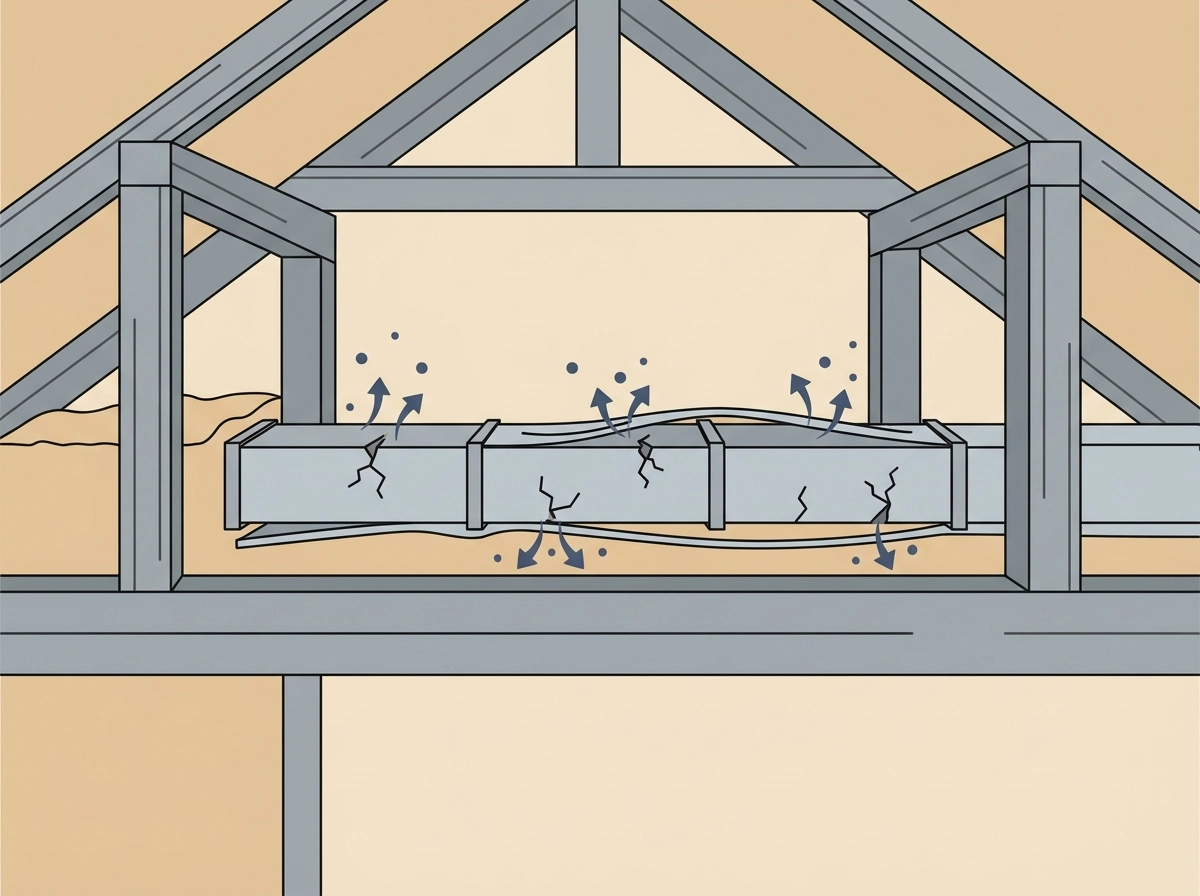
Phoenix attics are among the most thermally aggressive environments that residential ductwork faces anywhere in the United States. Attic temperatures regularly reach 160 degrees Fahrenheit or higher during summer, and with Phoenix logging 145 days of 100-degree-plus temperatures in 2025, that punishment is not brief. It lasts for months. No other major U.S. market exposes ductwork to this combination of peak heat intensity and sustained duration, which means failure mechanisms that develop slowly elsewhere accelerate rapidly here.
The physics of what happens inside that attic are straightforward and damaging. As temperatures climb each morning, duct material expands. As the attic cools overnight, it contracts. This expand-and-contract cycle repeats hundreds of times across a single cooling season. Over time, the repeated movement loosens joints, separates connections, and opens gaps where conditioned air can escape directly into the attic instead of traveling to your living spaces. In older homes where duct tape was used as a sealant instead of mastic, this process happens even faster because the adhesive degrades under sustained heat. Studies show that a typical home loses 20 percent or more of its conditioned air through duct leaks. In a Phoenix home, every one of those leaked cubic feet represents money spent cooling your attic rather than your bedroom.
Leaky ducts are genuinely the most underdiagnosed airflow problem in Phoenix homes, and most homeowners have no idea they exist because the symptoms look exactly like an undersized or aging AC system.
Insulation degradation is a separate problem that compounds the leakage issue. Even ducts with intact seals lose efficiency when their insulation has degraded through years of thermal cycling. Air traveling through poorly insulated ductwork absorbs heat before it ever reaches your vents, meaning your system delivers warmer air and runs longer to compensate.
The fix: Schedule a professional duct inspection that includes both pressure testing and thermal imaging. Pressure testing quantifies exactly how much air is escaping; thermal imaging locates where it is happening. Critically, pre- and post-sealing test results are often required documentation to qualify for available rebate programs, so homeowners should confirm this before service is completed. SRP offers a dedicated duct test and repair rebate for qualifying customers, and APS offers up to $250 per duct system plus additional insulation incentives. With a projected APS rate increase of 13.9 percent anticipated for 2026, the cost of ignoring leaky ductwork is measurably higher this year than last.
Blocked or Damaged Outdoor Condenser Unit
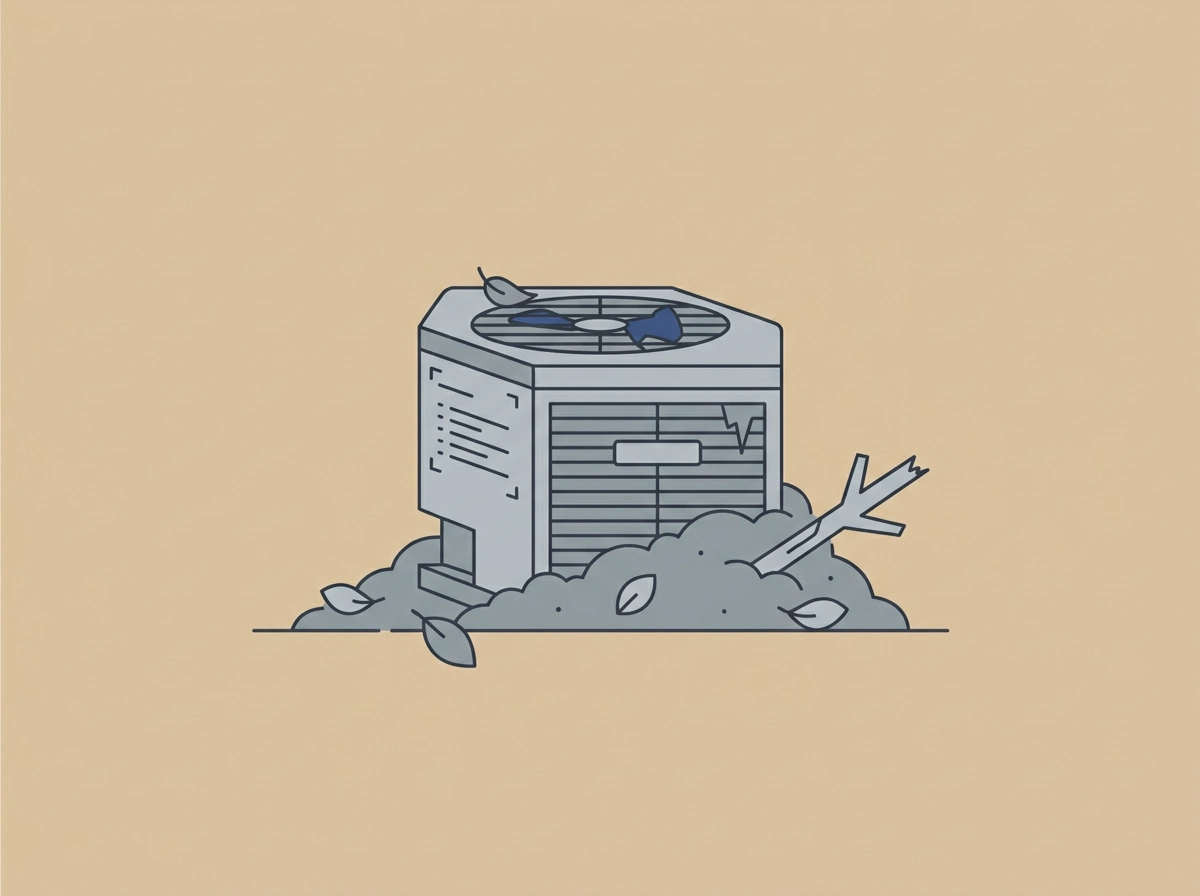
Your outdoor condenser unit works hardest precisely when it is most vulnerable. In the Phoenix Valley, that means operating through extreme heat, relentless dust, and soil conditions that can quietly undermine the unit's foundation over time.
Clearance and debris are your first concern. Condenser units require at least two feet of clear space on all sides to pull in ambient air and exhaust heat effectively. Shrubs that looked manageable last spring have likely grown into that buffer zone. Fence panels installed too close to the unit, stacked storage, and windblown debris pile against the coil grille and choke the airflow the system depends on. When that intake is restricted, heat cannot escape the refrigerant efficiently, the compressor runs longer cycles, and your energy bill climbs even when nothing feels obviously wrong.
Haboobs compound the damage with every event. Phoenix sits in one of the most active dust-storm corridors in North America, and each haboob drives fine, silica-rich desert particulate deep into condenser fins. This is not ordinary household dust. According to research on how dust storms impact AC condenser efficiency, contaminated coils can push head pressure 10 to 15 percent above design limits, forcing the compressor to absorb cumulative stress with every subsequent cycle. Most homeowners do not notice the problem immediately because the post-storm temperature drop temporarily masks the efficiency loss. Within three to five days, as outdoor heat rebounds, the coil's reduced capacity becomes undeniable. For a deeper look at how Phoenix dust storms damage your HVAC system, the damage mechanism is well documented and entirely preventable with timely cleaning.
Bent or damaged fins make a bad situation worse. Physical damage to condenser fins, whether from hail, debris impact, or rough handling during past service visits, reduces the surface area available for heat exchange. Dirty fins restrict airflow; bent fins reduce transfer capacity. When both problems exist simultaneously, the efficiency loss is compounding rather than additive.
Do not overlook the pad beneath the unit. Caliche soil, the calcium carbonate-hardened layer common throughout the Phoenix Valley, shifts and settles unevenly over time. A condenser unit that tilts even slightly stresses the compressor internally and disrupts proper refrigerant flow through the system.
The fix is straightforward. Walk your unit today, clear all vegetation and debris within a two-foot perimeter, and schedule a professional tune-up that includes fin cleaning, fin straightening, and a level check. Dust and AC performance issues are entirely addressable with annual professional maintenance, which typically runs between $75 and $150, a fraction of what a neglected compressor will eventually cost to replace.
Undersized or Unbalanced Duct System
Many Phoenix homes were built decades ago with ductwork designed around a specific floor plan that may no longer exist. Room additions, converted garages, and open-concept remodels all place demand on a duct system that was never engineered to serve those spaces. The result is a network of supply and return ducts that is fundamentally mismatched to the home it is now expected to condition, regardless of how well your equipment is performing.
An undersized duct system creates a hard ceiling on airflow performance. Even when your air conditioner, blower motor, and refrigerant charge are all functioning correctly, conditioned air cannot reach its destination fast enough if the ducts carrying it are too narrow for the system's output. The air has nowhere to go except back into the system, which increases static pressure, strains components, and leaves rooms chronically uncomfortable no matter how low you set the thermostat.
Duct imbalance introduces a different but equally frustrating problem. When supply and return capacity are mismatched across zones of the home, some rooms end up pressurized while others sit under negative pressure. Practical symptoms homeowners notice include interior doors that swing open or closed on their own, rooms that never reach the thermostat setpoint, and uneven humidity levels between areas of the house. These are not minor inconveniences; they are diagnostic signals pointing to a structural airflow problem.
The industry-standard tool for evaluating this is a Manual J load calculation, which accounts for your home's current layout, insulation values, window exposure, and equipment output to determine whether your duct system is properly sized. This is not a quick visual inspection; it is a methodical engineering assessment that should only be performed by a licensed HVAC contractor. Note that a duct cleaning and a duct system evaluation are entirely different services; only the latter diagnoses sizing and balance problems.
If your home has been modified since it was built, or if you have never had a formal airflow assessment, contact Gray Goat Air to schedule a duct system evaluation and Manual J review. Persistent comfort problems rarely resolve themselves without addressing the underlying infrastructure.
No Zoning System or Single-Thermostat Control
Even the most efficient air conditioner in Phoenix cannot overcome a fundamental physics problem: your home has multiple microclimates, and a single thermostat only sees one of them. West-facing rooms absorb intense solar heat gain during afternoon hours, sometimes adding 10 to 15 degrees of localized warmth while a shaded north-facing bedroom stays perfectly comfortable. When your thermostat calls for cooling, the system runs until that one sensor is satisfied, leaving the sun-baked rooms still uncomfortable or over-cooling the shaded ones to compensate. One fixed setpoint cannot resolve two opposite conditions happening simultaneously, and no amount of filter cleaning or duct sealing will fix that underlying limitation.
The good news is that the industry has a well-developed solution. Zoning systems use motorized dampers installed inside your ductwork to direct conditioned air precisely to the areas that need it at any given moment. A central controller reads temperature sensors placed in each zone and opens or restricts dampers in real time, eliminating the hot-and-cold patchwork that plagues single-thermostat homes. According to the U.S. Department of Energy, a correctly designed and installed zoned system with programmable thermostats can reduce energy bills by up to 35 percent, a compelling figure for Phoenix homeowners facing summer utility bills that can run several hundred dollars per month.
Variable-speed air handlers are the natural companion technology for any zoned system. When dampers close off portions of the ductwork, a fixed-speed blower creates excess static pressure that strains equipment and wastes energy. A variable-speed air handler modulates its output to match the reduced demand of a partially closed zone system, running longer at lower intensity rather than blasting full capacity on every cycle. This also improves humidity removal during Phoenix monsoon season, when comfort depends as much on moisture control as temperature. Industry sources tracking HVAC zoning system trends confirm that homeowners are actively requesting zoning conversations with contractors in 2026, making this a mainstream upgrade rather than a niche investment.
For homeowners with larger properties or multiple stories, ask your HVAC contractor about a smart zoning assessment. The combined energy savings and comfort improvement typically justify the investment within two to three Phoenix cooling seasons.
Why Ductless Mini-Splits Solve Airflow Problems at the Source
Every airflow problem covered in this list traces back to ductwork in some form: leaky joints, undersized trunks, attic heat gain, or pressure imbalances caused by a system stretched beyond its original design. Ductless mini-splits take a fundamentally different approach by removing ducts from the equation entirely.
A mini-split system delivers conditioned air directly into each room through a compact wall-mounted air handler connected to an outdoor unit by a small refrigerant line. There are no attic ducts absorbing heat, no leaking joints bleeding conditioned air into unconditioned spaces, and no trunk lines creating pressure imbalances across your floor plan. The U.S. Department of Energy estimates that duct losses account for 20 to 30 percent of conditioned air in a typical home. In a Phoenix attic reaching 160 degrees Fahrenheit, that loss is significantly compounded.
Because each indoor unit operates independently, mini-splits deliver genuine room-by-room control. You can cool a home office during work hours, set bedrooms cooler at night, and avoid conditioning rooms that are unoccupied, all without the pressure conflicts that plague single-thermostat central systems.
Mini-splits are also the preferred solution for spaces where extending existing ductwork is impractical or would overload an already undersized system. Phoenix home additions, garage conversions, casitas, and detached home offices are ideal candidates. Running new ductwork through finished walls or an overloaded air handler is rarely the right answer when a ductless unit can be installed in one to two days without structural modifications.
For homeowners considering a whole-home upgrade, multi-zone mini-split systems pair inverter-driven efficiency with smart zoning in a single platform, delivering performance that central systems with aging ductwork simply cannot match.
Gray Goat Air sells, installs, and services mini-split systems throughout the Phoenix area. If you have a room that has never been comfortable regardless of what your central system does, that is exactly the problem ductless technology was built to solve. Contact us to talk through whether a mini-split is the right fit for your home.
Airflow Is a Safety Issue in Phoenix, Not Just a Comfort One
Phoenix does not have a forgiving climate. The city logged 145 days of 100-degree-plus temperatures in 2025, shattered its earliest-ever triple-digit record on March 18, 2026, and Maricopa County recorded 427 heat-related deaths in a single year. By early July 2026, confirmed heat deaths were already double the pace of the prior year at the same calendar point. In this environment, airflow failure is not a nuisance you schedule around. It is a medical emergency waiting for a trigger.
The encouraging reality is that every problem covered in this article is preventable. Most airflow failures give clear warning signs weeks or months before they force an emergency replacement costing $3,000 to $8,000. A professional tune-up at $75 to $150 catches the majority of these issues before they compound into system-wide failures.
Your immediate next step is straightforward. Walk your home today using this article as your checklist: inspect your filter, confirm every register is unobstructed, and verify your condenser has at least two feet of clearance. Resolve what you can yourself, then schedule a professional airflow diagnostic for anything that remains.
If you are ready to go further, contact Gray Goat Air to discuss airflow balancing, duct inspection, smart zoning, or a mini-split assessment built around your home's specific layout and heat load. In Phoenix, proactive beats reactive every time.
Conclusion
Phoenix summers are brutal, but a hot, stuffy home does not have to be your reality. The seven airflow problems covered in this guide share a common thread: small, often overlooked issues can quietly sabotage your comfort and drive up your energy costs. The fixes, however, are more accessible than most homeowners expect.
Here are the core takeaways: blocked vents and dirty filters restrict airflow significantly, duct leaks waste cooled air before it reaches you, and an unbalanced system forces your AC to overwork for disappointing results.
Now it is time to take action. Walk through your home today, inspect your vents, check your filters, and note any rooms that feel consistently warmer than others. If problems persist, contact a licensed Phoenix HVAC professional. Small improvements to your airflow can deliver big results in comfort and savings.