
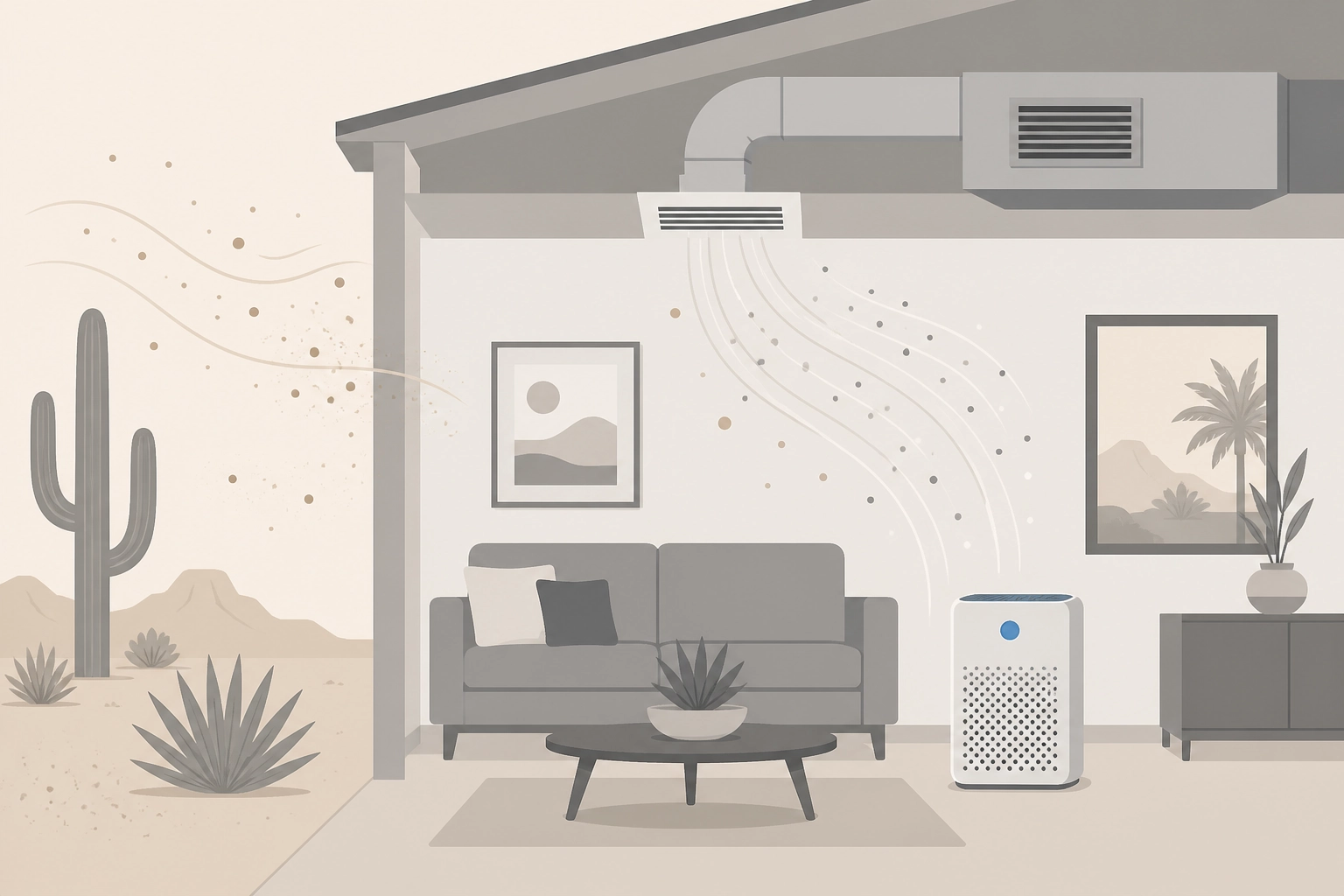
Most indoor air quality advice was written for homes that open their windows in spring, run the heat a few months a year, and give the house a chance to breathe. Phoenix homes are different. When you run your air conditioner for nine or more months straight in a tightly sealed house, the air inside your home behaves in ways that standard guides simply do not cover.
The desert creates a specific combination of problems: fine particulate dust that infiltrates everything, seasonal allergens that accumulate rather than clear out, and dry air that swings between extremes depending on the season and your HVAC settings. Sealing your home to keep the heat out also seals in everything you would rather not breathe.
This guide was written specifically for Phoenix homeowners. It will walk you through why desert indoor air quality is a distinct challenge, what is actually circulating inside your home, and which practical improvements deliver the most meaningful results. You do not need to replace your entire system. You need the right information and a clear plan, and that is exactly what you will find here.
Why Phoenix Indoor Air Quality Is a Different Problem Entirely
Most indoor air quality guides assume something Phoenix homes never get: a seasonal reset. In climates with mild springs and falls, homeowners crack windows for weeks at a time, flushing out accumulated dust, allergens, and volatile organic compounds naturally. That passive ventilation cycle dilutes pollutants without any equipment or effort. Phoenix homeowners don't have that option.
Here, HVAC systems run for 9+ months annually, and the same air circulates through a sealed envelope continuously. Dust, allergens, VOCs from building materials and cleaning products, and fine particulates don't get flushed out between seasons. They recirculate. The EPA notes that indoor pollutant concentrations are often 2 to 5 times higher than outdoor levels in typical homes; in a sealed desert home running AC nearly year-round, the absence of any natural dilution cycle compounds that baseline significantly.
The desert environment adds a second layer that national guides ignore entirely. Fine caliche dust, silica particles from blowing soil, and heavy pollen from non-native landscaping such as olive and mulberry trees enter homes constantly, tracked in on shoes and clothing or pulled through HVAC fresh-air intakes. Unlike organic particulates in humid climates, desert dust is inorganic and doesn't break down. It simply accumulates.
This framing matters before anything else, because solutions built for humid, seasonally ventilated homes often miss the actual problem in Phoenix. Dry-climate IAQ solutions differ from humid-climate defaults, and a ventilation strategy borrowed from a Pacific Northwest guide may introduce more desert particulates than it removes. Understanding how HVAC works differently in Phoenix than the rest of the country is the foundation every other improvement depends on. The rest of this analysis builds from that starting point.
The Sealed-Home Concentration Effect: How AC Makes Indoor Air Worse Over Time
Understanding why sealed homes accumulate pollutants makes the problem easier to solve.
Every time your air handler runs, it draws return air back through the system. Any dust, skin cells, pet dander, and fine particles riding that airstream get recirculated into your living space unless the filter captures them first. The same air cycling through a sealed home for the better part of a year demands a filter that performs consistently, not merely adequately.
Dry air makes this worse in a way that surprises most homeowners. In humid climates, airborne particles absorb moisture, grow heavier, and settle onto surfaces relatively quickly. In Arizona's low-humidity air, those same particles stay suspended far longer, extending their window of inhalation with every HVAC cycle. What settles in a Boston home within hours may still be airborne in a Scottsdale home the next morning.
Ductwork compounds the problem. Small leaks in sealed duct systems, common in older Phoenix homes, don't just waste conditioned air. On the return side, negative pressure actively pulls in air from surrounding spaces, and in Phoenix that often means attic air. Phoenix attics can reach extreme temperatures in summer, and that superheated air carries fine dust directly into the living space, bypassing the filter entirely. Leaky or poorly insulated attic ductwork is one of the most overlooked sources of indoor dust in Valley homes.
The tight-envelope design that makes a home energy efficient also traps volatile organic compounds (VOCs) from building materials, cleaning products, and furnishings. Without meaningful fresh-air exchange, those compounds accumulate steadily. The tighter the home, the higher the concentration over time. These effects compound over the months-long operating season that defines Phoenix HVAC use.
The pattern is consistent: continuous operation, dry air, duct leaks, and minimal ventilation all push in the same direction, steadily degrading the air quality inside a home that looks, from the outside, completely normal.
Desert Allergens and Dust: What Is Actually in the Air Inside a Phoenix Home
Knowing why air recirculates is only half the picture. The other half is understanding what Phoenix air actually carries, because the specific mix of irritants in Valley homes differs meaningfully from what guides written for other climates describe.
The suspended-particle problem starts with humidity. In Arizona's dry winters, indoor relative humidity can drop to very low levels in winter. Fine particles stay airborne far longer than in humid environments, where moisture causes them to clump and fall faster. Many Phoenix residents blame outdoor conditions for sneezing, itchy eyes, and congestion, but the air inside their sealed, continuously recirculating home is often the more accurate culprit.
The dominant irritants here are not dust mites. Dust mites thrive in humid conditions rarely found in Valley homes. What replaces them is mineral dust: caliche, silica, and fine inorganic particles the desert generates in abundance. University of Arizona research on indoor dust composition confirms elevated concentrations of silicon and other mineral-derived elements in Arizona home dust, pointing to indoor accumulation as a distinct, ongoing process.
Pollen is a seasonal but significant factor. Non-native landscaping such as olive and mulberry trees contributes meaningfully to Valley pollen loads each spring. Pollen enters homes through open doors, on clothing, and through HVAC fresh-air intakes, landing in ductwork where it recirculates until filtered or cleaned out.
Pet dander in a sealed home has no exit path. Without meaningful ventilation or strong filtration, dander settles into ductwork and on surfaces, then re-enters the breathing zone every time the air handler runs. This accumulation pattern affects mini splits as well, as detailed in this guide to mini split maintenance in the Phoenix desert.
Mold is less common in Phoenix than in wetter climates, but it is not absent. It concentrates around evaporative cooler pads, poorly drained condensate lines, and bathrooms without functioning exhaust ventilation: targeted, predictable locations rather than the broad household mold risk common in humid regions.
Humidity in a Desert Home: Why Both Extremes Damage Air Quality
Dust and allergens don't tell the whole story of Phoenix indoor air. Humidity, or the persistent lack of it, shapes how irritating that air actually feels inside your lungs.
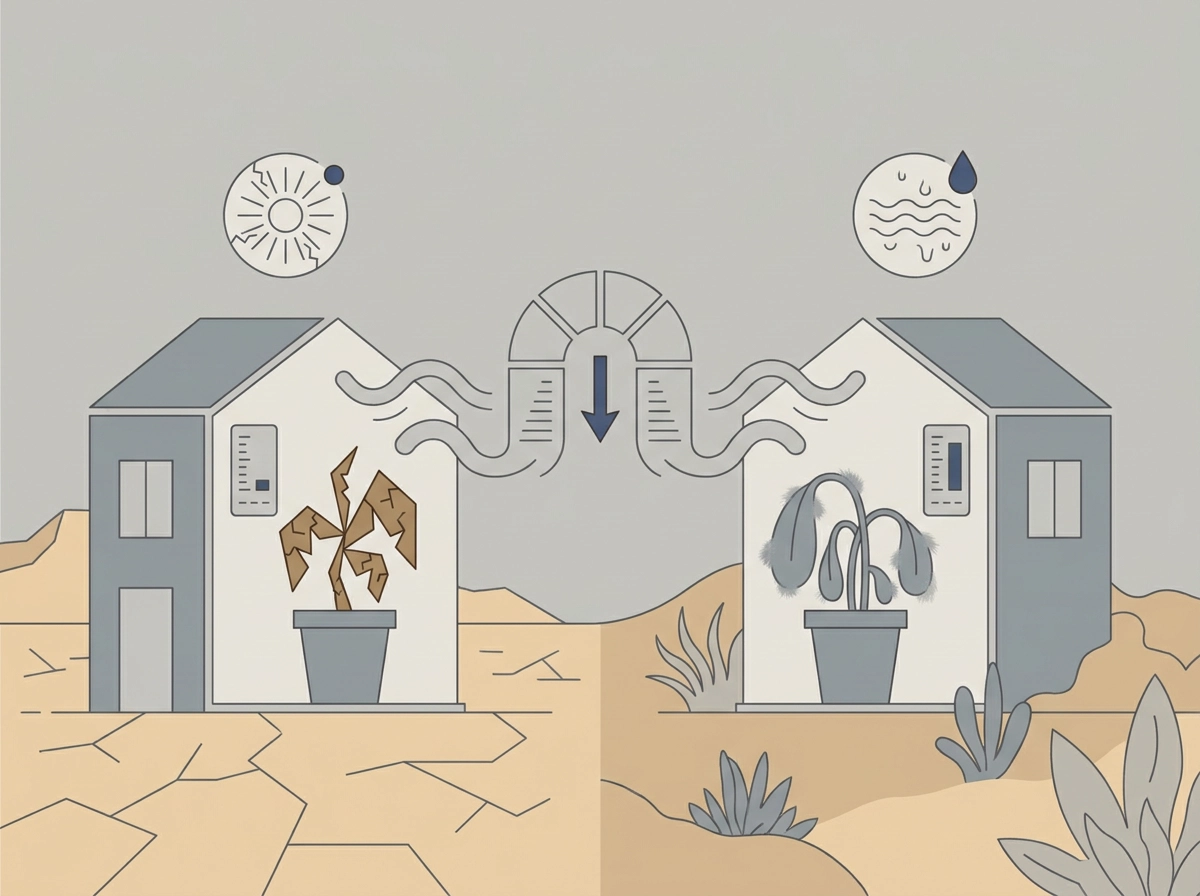
Industry guidance identifies a range around 30 to 50 percent relative humidity as generally comfortable and healthy. Phoenix homes can experience very low indoor humidity through winter months. Very dry air can impair your body's natural ability to filter airborne particles. Every irritant discussed in the previous section hits harder when that natural defense is compromised.
Your air conditioner is part of the problem. As refrigerant absorbs heat from indoor air, it also condenses and removes moisture. That's intentional engineering for humid climates, but in Phoenix, where outdoor air is already dry, running the AC for 9+ months a year compounds the natural desiccation. The system that keeps you cool is quietly stripping the air of what little humidity it had.
A whole-home humidifier integrated directly into your HVAC system addresses this without the hassle of refilling and cleaning multiple room units. It operates automatically, drawing on your home's water supply and distributing moisture through the same ducts that carry conditioned air. For larger Valley homes, it's sized to match the square footage in ways a portable unit simply cannot.
Then July arrives and the calculation flips entirely. During monsoon season, outdoor humidity rises sharply; if that humidity enters a home, it can create temporary conditions that support mold growth. The key defense is a correctly sized AC system. An oversized unit cycles on and off quickly and may not run long enough for effective dehumidification. Monitoring a simple indoor hygrometer during monsoon season and scheduling a check-in through your HVAC maintenance in Phoenix routine lets you catch humidity spikes before they cause damage.
Filtration Strategies That Actually Work in a Desert Climate
Humidity management addresses one dimension of Phoenix's IAQ challenge. Filtration addresses another, and in a desert home running sealed year-round, it matters more than most homeowners realize.
The filter in your system right now may be doing almost nothing useful. Standard 1-inch fiberglass filters (MERV 1-4) capture large debris like lint and hair, but they allow fine dust, pollen, and respiratory particles to pass freely. The EPA confirms these filters capture particles in the 3-10 micron range at less than 20% efficiency.
MERV 8 to MERV 13 is the practical upgrade range for most Phoenix households. These filters capture particles in the 1-10 micron range, which covers most pollen, dust, and pet dander, without the airflow restriction that causes system strain. For most air handlers in Phoenix homes, MERV 11 or MERV 13 delivers a meaningful IAQ improvement without stressing the blower motor.
MERV 16 and HEPA-level filters capture finer particles but require a verified match with your air handler's blower capacity. Forcing high-density media into an undersized system restricts airflow, strains components, and raises energy consumption. An HVAC technician can confirm whether your system can support it before you buy.
For particles under 1 micron, a standalone HEPA air purifier placed in a bedroom or primary living area adds a secondary filtration layer the central system cannot match. These units work independently of ductwork, making them effective regardless of your central system's filter rating.
Replacement intervals are where Phoenix homeowners most commonly lose their IAQ gains. The 90-day schedule standard in moderate climates is too infrequent here. During dry, windy periods, filters can load significantly faster than in moderate climates -- check monthly and replace when visibly loaded. Because Phoenix HVAC systems operate under conditions that accelerate wear and reduce filter life faster than the national average, incorporating filter inspection into a structured maintenance plan is the most reliable way to sustain the gains filtration upgrades provide.
Ventilation Beyond Filtration: How to Introduce Fresh Air Without Wrecking Efficiency
Ventilation solves the upstream problem that filtration alone cannot: too much of the same air, recirculated indefinitely through a sealed envelope.
Energy Recovery Ventilators: The Efficient Answer
An Energy Recovery Ventilator (ERV) is the most effective ventilation upgrade for a sealed Phoenix home. It works by simultaneously exhausting stale indoor air and drawing in fresh outdoor air, but the two streams pass through a heat-exchange core before they separate. The outgoing cool air pre-conditions the incoming hot outdoor air, so your cooling system doesn't have to work nearly as hard to handle the fresh air load. The result is genuine fresh-air exchange with minimal impact on your energy bills, which matters when you're running a system nine or more months a year.
A properly sized ERV steadily dilutes VOC concentrations, CO2 buildup, and accumulated odors that no filter can address. Filters capture particles; they cannot remove gases or replenish oxygen displaced by occupants. An ERV handles both, without meaningfully raising cooling loads. For Phoenix homeowners weighing any ventilation upgrade against efficiency concerns, this balance is the central argument for ERVs. They also fit naturally into an energy-efficient HVAC system configuration for Phoenix homes, pairing well with variable-speed equipment.
Balanced vs. Exhaust-Only Systems
ERV systems provide balanced ventilation, meaning equal volumes of air are supplied and exhausted. That balance matters structurally: pressure stays neutral, so your home doesn't pull attic dust or unconditioned air through duct leaks and wall penetrations to compensate for an air deficit.
If an ERV isn't in the budget yet, timed exhaust fans in bathrooms and the kitchen offer a lower-cost starting point. Running them on 20-minute timer cycles provides some fresh-air turnover with no added equipment beyond a timer switch. The tradeoff is slight negative pressure inside the home, which can draw dusty outdoor air through envelope gaps. It's a meaningful improvement over no ventilation strategy, but it's a step toward balanced ventilation, not a substitute for it.
Ductwork and System Integrity: The Hidden Source of Desert Dust Infiltration
Ventilation strategies control what comes into your home, but ductwork determines what that air picks up along the way.
Many Phoenix homes built before modern energy codes were ducted through unconditioned attic spaces, and those systems can lose meaningful portions of conditioned air through leaks. Each leak point works in both directions: supply leaks waste cooled air, while the negative pressure created on the return side actively pulls attic air into the living space. Phoenix attics can reach extreme temperatures in summer, and that superheated air carries fine mineral dust, insulation fibers, and accumulated debris directly past your air filter.
Return-side leaks are the more serious IAQ threat. Because the air handler creates suction on the return side, any gap in return ductwork or the air handler cabinet draws in unfiltered attic air before it ever reaches the filter. The filter only cleans what passes through it correctly; return-side infiltration bypasses that protection entirely.
Sealing ductwork addresses the problem at the source. Mastic sealant at joints is a more durable long-term solution than foil tape. Aeroseal, a professionally applied sealant system that reaches otherwise inaccessible joints, reduces both dust infiltration and energy waste simultaneously, since less conditioned air escapes to the attic.
Extreme desert heat accelerates degradation of duct tape and even mastic over time, meaning a system sealed adequately in 2005 may be leaking again today. Annual duct inspections, built into a structured air conditioner maintenance plan, catch developing leaks before they compound.
The most complete solution, available during a new build or major system replacement with targeted efficiency upgrades, is relocating ductwork inside the conditioned envelope entirely. Ducts inside conditioned attic space or interior chases never contact the superheated attic environment, eliminating the infiltration problem at the system level rather than managing it after the fact.
The Connection Between Energy Efficient Air Conditioning and Better Indoor Air
Fixing duct leaks addresses what enters the system; equipment design determines how well the system cleans the air once it's running.
A properly sized HVAC system runs in longer, steadier cycles rather than short bursts. Each cycle is an opportunity to pull return air through the filter, so longer run times translate directly into a higher total volume of air cleaned per day. A system that cycles on and off every few minutes delivers far fewer filter passes over 24 hours than one running in sustained, lower-intensity cycles.
An oversized unit cycles on and off quickly and may not run long enough for effective dehumidification. As noted in the humidity section, short-cycling also undermines moisture removal -- a compounding problem in monsoon season. Oversized systems also provide fewer total filter passes per day, a common IAQ complaint in Phoenix homes where systems were upsized during a replacement, often with good intentions but without accounting for those costs.
Two-stage and variable-speed systems solve this directly. Rather than running at full capacity until the thermostat is satisfied, these systems modulate output to match the actual cooling load. In practice, that means longer, lower-intensity run cycles that maintain more consistent temperature and humidity levels throughout the home. During Phoenix's long shoulder seasons, when the load is modest, a variable-speed system may run continuously at low output rather than cycling at all.
Filter performance improves as a byproduct. Lower-velocity airflow from a variable-speed system gives particles more contact time with filter media. For a deeper look at how equipment choice affects Phoenix performance, the single-stage vs. variable-speed systems comparison for Phoenix's climate covers the tradeoffs in detail.
The result is that energy efficient air conditioning is also a health investment. Lower utility bills and better IAQ come from the same operating characteristic: steady, sustained airflow rather than aggressive short cycles.
How a Structured Maintenance Plan Protects Phoenix Indoor Air Quality Year-Round
All of those efficiency gains only hold if the system stays clean and properly configured. That's where a structured air conditioner maintenance plan becomes the backbone of long-term IAQ management in Phoenix.
Standard maintenance plans include two visits per year, one before summer and one before winter. In Phoenix, the pre-summer inspection carries far more IAQ weight than its counterpart. It precedes nine-plus months of near-continuous operation, and the conditions heading into that stretch determine the air quality in your home for the entire cooling season.
What a thorough maintenance visit should include:
Evaporator coil cleaning. Dirty coils can degrade air quality and reduce system efficiency.
Condensate drain and drain pan clearing. Standing water in the drain pan can become a mold source, particularly in systems running continuously through summer.
Filter inspection and replacement. A technician can confirm the correct MERV rating is installed and flag whether the replacement interval matches actual dust loading in the home.
A maintenance visit is also the right time to assess duct integrity. A technician can identify return-side leaks, disconnected joints, and insulation that has degraded under attic heat. These findings affect both system efficiency and IAQ directly, and catching them during a scheduled visit costs far less than diagnosing them after symptoms appear.
The documentation a maintenance plan creates is often undervalued. When a homeowner reports that allergy symptoms worsened noticeably one summer, a complete service history narrows the cause quickly by showing what changed: filter type, coil condition, refrigerant charge, duct findings. Without that record, diagnosis is guesswork.
Gray Goat Air's maintenance plans are built around Phoenix's specific operating conditions, not a generic national template designed for climates with shorter cooling seasons and more forgiving dust loads.
Ranking the Improvements: Where Phoenix Homeowners Get the Most IAQ Return
A maintenance plan keeps the system honest. This tier framework decides what to fix first.
The improvements below are sequenced by cost and impact. Work through them in order; each tier removes the vulnerabilities that would otherwise undermine the tier above it.
Tier 1: Immediate, low cost
Swap your current filter for a MERV 11 or MERV 13 and set a 30-day replacement reminder from October through May, when Phoenix dust loads peak. While you're at it, vacuum the return air grilles and visible duct registers. Accumulated debris on grilles restricts airflow and sends a burst of particles into the system every time the blower starts.
Tier 2: Moderate investment
Schedule a professional duct inspection and seal any identified leaks with mastic or aerosol-based sealant. Leaky return ducts pull unfiltered attic dust directly into the airstream, bypassing the filter entirely. Once duct integrity is confirmed, add a standalone HEPA purifier to the primary bedroom. Sleep-time exposure is long and uninterrupted, making the bedroom the highest-priority room for secondary filtration.
Tier 3: System-level upgrade
Add a whole-home humidifier to address winter dry air, which keeps indoor relative humidity above comfortable levels and reduces the airborne particle suspension that low-RH conditions worsen. If occupants notice persistent headaches, stale odors, or fatigue despite good filtration, an Energy Recovery Ventilator is the appropriate next step. An ERV introduces fresh air while recovering most of the cooling energy from the exhaust stream, making it compatible with energy efficient HVAC operation.
Tier 4: Replacement cycle
When the existing system reaches end of life, specify a variable-speed air handler paired with a two-stage or inverter-driven compressor. Variable-speed equipment runs longer, steadier cycles at lower velocity, improving both filter performance and humidity control while lowering operating costs. The efficiency and air quality benefits arrive together.
Skipping tiers rarely saves money. High-end equipment installed over leaky ducts and a clogged filter simply circulates the problem at greater expense.
Taking Control of the Air Inside Your Phoenix Home
The tiered approach described above delivers the most return when maintained consistently. Phoenix's 9-plus months of continuous HVAC operation, combined with the Sonoran Desert's fine particulate load, means degradation happens faster here than in virtually any climate the standard homeowner guides were written for.
The near-term, lower-cost steps -- upgraded filtration, shorter replacement intervals, and duct assessment -- address the mechanisms driving most of the air quality complaints Valley homeowners report. Humidity management, controlled ventilation, and system efficiency upgrades compound those gains, with each layer reinforcing the one beneath it.
What prevents those gains from eroding over a single cooling season is a structured maintenance plan. Coil cleaning, condensate drain clearing, filter inspection, and duct integrity checks need to happen on a schedule calibrated to Phoenix's operating reality, not a generic national template written for climates where systems rest for months at a time.
Gray Goat Air works exclusively with Phoenix-area homeowners and structures its maintenance plans, system assessments, and equipment recommendations around the Valley's specific demands. If your home is dustier than it should be, if allergy symptoms are worse indoors than out, or if you simply want a professional evaluation of where your system stands before peak cooling season, contact the Gray Goat Air team to schedule an IAQ-focused inspection. The air inside your home is worth the same attention you'd give the system producing it.
Conclusion
Phoenix homes face indoor air quality challenges that most national guidance simply does not address. Extreme heat forces systems to run constantly, sealing in pollutants. Desert dust and allergens infiltrate through duct leaks and degraded filtration. Humidity swings in both directions keep irritants airborne for longer.
The good news is that targeted improvements deliver real, measurable results. Better filtration, tighter ductwork, controlled ventilation, and a maintenance schedule built for Valley conditions work together to transform the air inside your home.
You spend more time indoors than anywhere else. That air deserves serious attention.
If your home feels dustier than it should, or if symptoms are worse inside than outside, Gray Goat Air is ready to help. Contact the team today to schedule an IAQ-focused inspection and take the first step toward cleaner, healthier air this cooling season.