
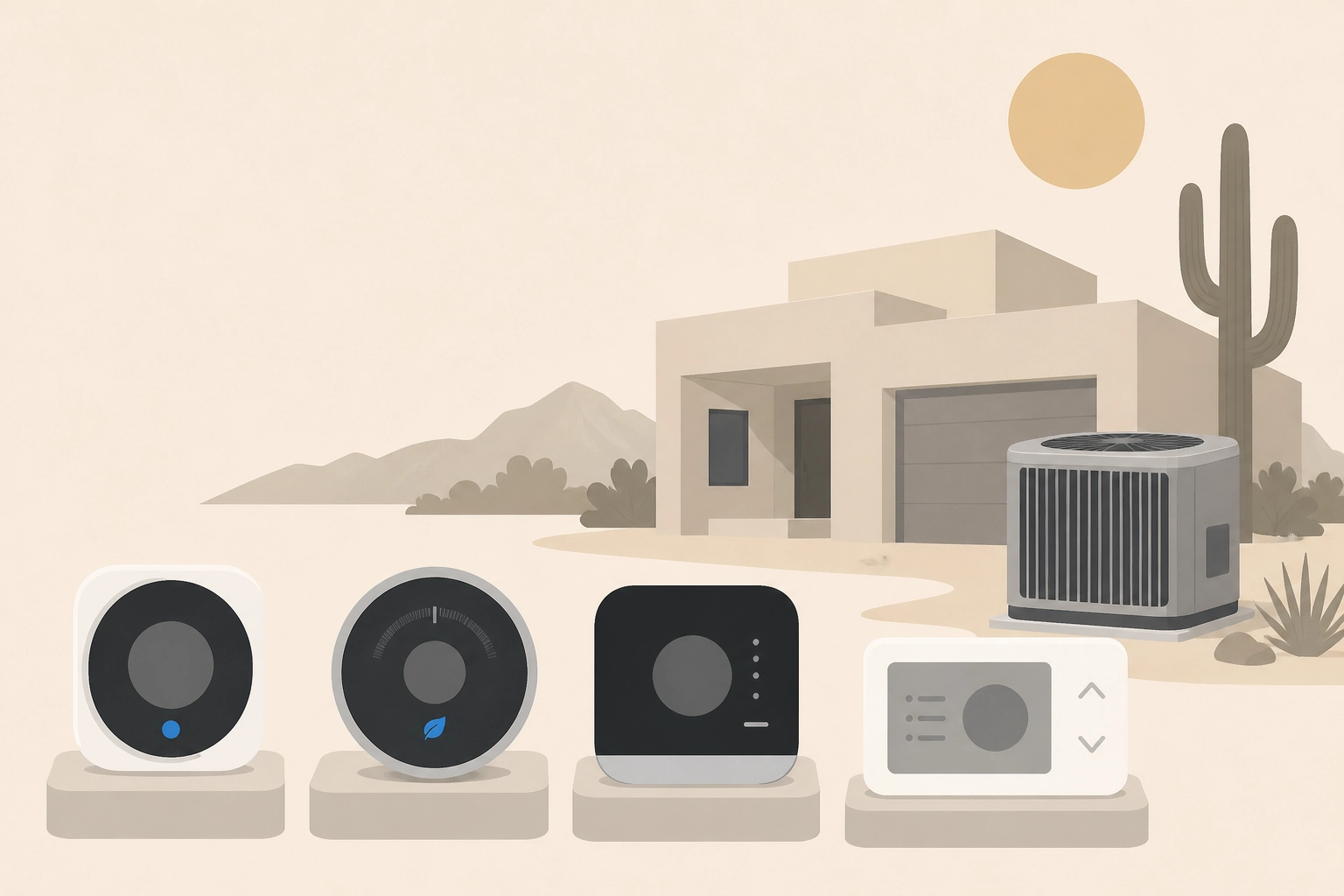
Phoenix summers don't just test your patience. They test your entire cooling system for five to six months straight, often pushing AC units to run for extended daily stretches at high capacity. A standard programmable thermostat was never built for that workload, and most generic smart thermostat guides weren't written with the Sonoran Desert in mind either.
A thermostat upgrade can meaningfully reduce your cooling bills, but only if the model you choose is equipped to handle long daily runtimes, aggressive temperature swings, and the compatibility demands of Phoenix-area AC systems. Get it right, and you're looking at 15 to 20 percent savings on cooling costs. Get it wrong, and you've spent $200 on a device that underperforms your old one.
This guide cuts through the noise. You'll find a direct comparison of the top smart thermostat models evaluated against Phoenix-specific criteria, an honest look at where each one falls short or excels in desert conditions, practical configuration advice, and a breakdown of local utility rebates that can offset your upfront cost. By the end, you'll know exactly which thermostat is worth buying for your home.
Why Phoenix Cooling Demands Are Unlike Any Other Climate
Most smart thermostat algorithms were built around a core assumption: overnight temperatures drop, the home recovers, and the system rests. In Phoenix, AZ, that assumption breaks down completely.
During peak summer months, Phoenix AC systems can run for extended stretches far beyond what northern or coastal systems require. That isn't a minor regional variation; it's a fundamentally different operating environment that affects equipment longevity, energy costs, and how a thermostat needs to be programmed.
Overnight temperatures in July and August often remain unusually high, providing little overnight recovery. The nighttime recovery window that national thermostat platforms depend on for energy-saving calculations simply doesn't exist here. A thermostat expecting a 65°F overnight low will mistime pre-cooling and leave a home uncomfortable by mid-morning.
When outdoor temperatures hit 110°F or higher, compressors work near the edge of their rated capacity. Setback calculations become more consequential: setting the away temperature too high means the system needs hours to recover, wiping out any savings. Getting that balance right requires a thermostat configured specifically for desert conditions.
Monsoon season adds another variable from July through September. Rapid humidity swings affect perceived comfort and can cause thermostats optimized purely for dry heat to undershoot cooling targets when moisture levels spike unexpectedly.
Phoenix's cooling season extends well beyond what most U.S. markets experience, running from early spring through late fall. That extended season changes the return-on-investment math significantly.
What Makes a Smart Thermostat Actually Capable in Desert Conditions
Those demanding Phoenix conditions expose exactly which thermostat features are marketing claims and which are genuine engineering. Six capabilities separate a thermostat that handles desert cooling from one that merely tolerates it.
Setback tolerance without fault states. A Phoenix home routinely swings between setpoints, such as swinging between 85–88°F unoccupied and 76–78°F occupied, a gap some thermostats mishandle. Some thermostats interpret that range as a system fault or throttle compressor staging during recovery, extending the time and energy required to pull the home back down. Confirm that any model you consider handles this range cleanly before buying.
Learning algorithms calibrated to long cycles. In Phoenix, a thermostat trained on moderate-climate runtimes will start pre-cooling too late, leaving the home warm when occupants arrive. Look for models that allow manual pre-cool lead times as a fallback while the algorithm adapts.
Multi-stage and variable-speed compressor compatibility. Two-stage and variable-speed systems are now the standard in smart thermostats and zoning systems that maximize efficiency. A thermostat without Y1/Y2 staging terminals runs these systems at full capacity only, cutting efficiency and comfort simultaneously.
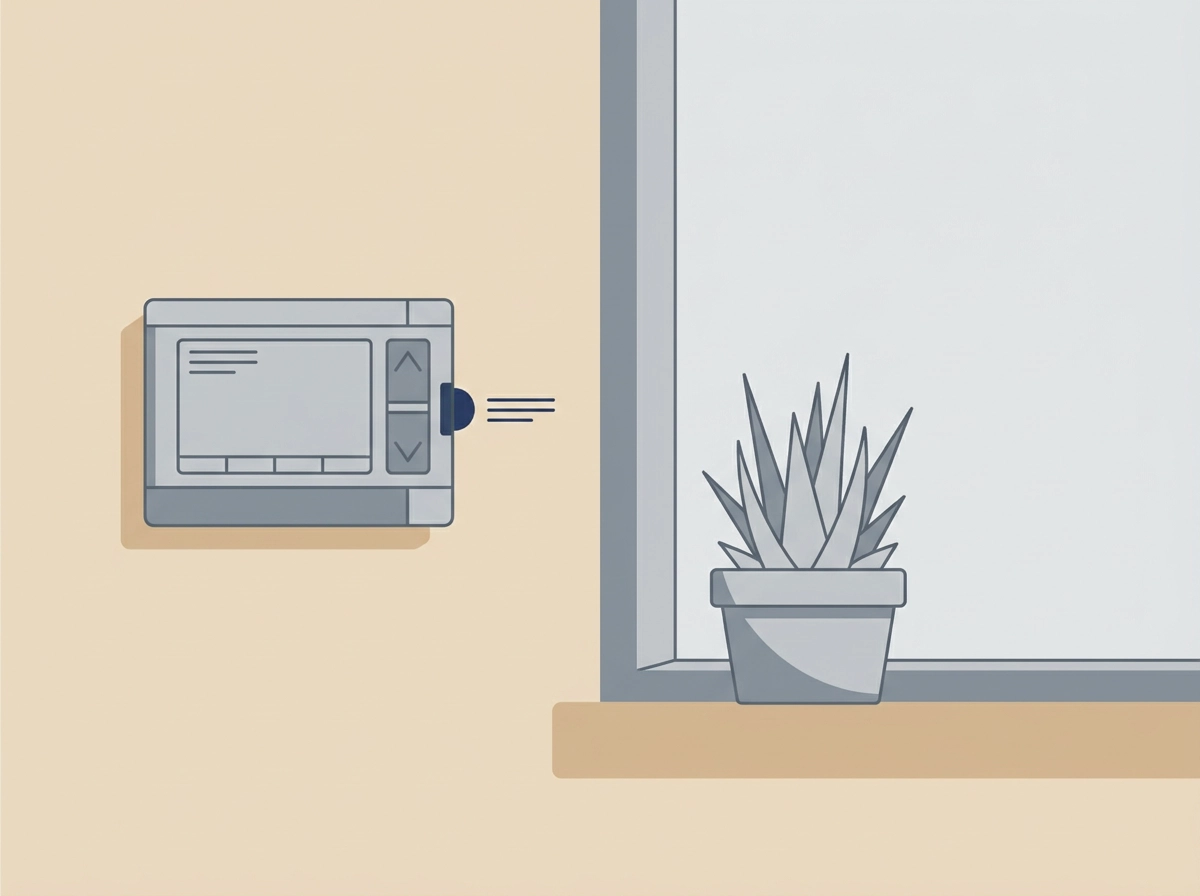
Remote sensors for stratification. Vaulted ceilings, west-facing windows, and attached garages can create significant room-to-room variation. Remote sensors let the thermostat average across occupied spaces rather than reading a single wall location.
Demand response integration. Both SRP and APS run programs that briefly adjust setpoints during peak grid events in exchange for bill credits. Only thermostats with remote connectivity and certified demand response capability qualify.
Operating range of the hardware itself. Thermostats mounted in warmer interior locations need to function reliably at elevated ambient temperatures. Check the manufacturer's rated operating range before installation placement is finalized.
The Leading Models Compared on Phoenix-Specific Criteria
Four models dominate what Phoenix contractors install and both major utilities recognize for rebates: the Google Nest Learning Thermostat (4th Gen), Ecobee Smart Thermostat Premium, Honeywell Home T10 Pro, and Emerson Sensi Touch 2. Sticker price is the wrong comparison. After SRP and APS rebates, the cost rankings shift meaningfully, and the least expensive model upfront isn't always the lowest net cost.
Each model is evaluated here against criteria drawn directly from Phoenix conditions: setback range and recovery behavior, multi-stage and variable-speed compatibility, remote sensor support, SRP/APS rebate eligibility, and scheduling flexibility for long daily cooling cycles. Installation complexity is assessed against the two most common local configurations: standard split systems with a gas furnace air handler, and all-electric heat pump systems.
Model | Remote Sensors | Variable-Speed Support | Rebate Path | Best Fit |
|---|---|---|---|---|
Nest 4th Gen | 1 (Nest sensor) | Limited | SRP + APS | Two-stage split systems |
Ecobee Premium | Up to 32 | Yes | SRP + APS | Multi-zone, high-efficiency systems |
Honeywell T10 Pro | Up to 20 | Yes | Verify locally | Contractor-installed, larger homes |
Sensi Touch 2 | None | No | SRP | Single-zone, budget upgrades |
No single model leads every category. When making the right call for your Phoenix home, the decision hinges on three variables: your existing system type, whether multi-room sensor averaging matters for your floor plan, and which utility serves your address. Each model is covered in detail in the sections that follow.
Google Nest Learning Thermostat: Strong Features, One Desert Limitation
The Nest Learning Thermostat is the most recognizable name in this comparison, and for many Phoenix homeowners it delivers genuine value. Understanding where it excels and where it stops short is the difference between a satisfying upgrade and a frustrating one.
Auto-scheduling takes time to earn its value here. The Nest's learning algorithm is legitimately useful for optimizing pre-cool timing in Phoenix, but it needs several weeks of real-world use to calibrate to desert cooling patterns. First-summer performance will likely underwhelm; by the second season, the scheduling becomes noticeably more precise. Homeowners who evaluate the Nest in July and return it in August are abandoning the device before it has learned anything useful.
Two-stage compatibility is solid; sensor flexibility is not. The Nest pairs well with conventional two-stage split systems and supports its own temperature sensors, but sensor expansion options are more limited than competing platforms; verify current specifications on Google's website before purchasing. For Phoenix homes with significant room-to-room variation, that sensor ceiling is a real constraint worth factoring into the decision before purchase. Reviewing smart thermostat and connected home checks during maintenance can help identify whether your current setup would hit that limit.
Check the model's maximum Eco Temperature setting before purchase, as caps vary and some may align with Phoenix away-mode needs. Setting unoccupied setpoints too high risks humidity accumulation during monsoon season and extends recovery times beyond what a single cooling stage can manage comfortably before occupancy.
Rebate eligibility is a meaningful financial factor. The Nest qualifies for SRP's Energy Management Program and APS demand response; rebate amounts vary by program year, so confirm current terms directly with SRP and APS.
The one clear limitation: the Nest does not natively support variable-speed or modulating systems. Homeowners with newer, energy efficient HVAC equipment will need a compatible communicating thermostat instead.
Best fit: Phoenix homeowners with a conventional two-stage split system, on SRP, who prioritize easy setup over advanced sensor coverage.
Ecobee Smart Thermostat Premium: The Strongest Case for Multi-Zone Phoenix Homes
Where the Nest reaches its ceiling, the Ecobee Smart Thermostat Premium is built for exactly the problems Phoenix homes create.
Multi-sensor capability is the defining advantage. The Ecobee's SmartSensor system supports a large number of SmartSensors per thermostat, verify the current capacity on Ecobee's specification sheet. In Phoenix homes, west-facing bedrooms and rooms above attached garages are noticeably hotter than the thermostat's wall location during peak afternoon hours. A single-point reading makes those rooms uncomfortable while overcooling the rest of the house. If your home already struggles with no zoning system or single-thermostat control, sensor averaging is the most practical remedy short of a full zoning installation.
The "Follow Me" feature extends this logic further. Rather than locking control to the thermostat's fixed location, Follow Me averages temperature readings across whichever rooms are currently occupied. For Phoenix homes with poor return air distribution, this directly addresses the most common comfort complaint without requiring ductwork modifications.
Scheduling is equally well suited to desert use patterns. The Ecobee supports multiple comfort settings per day with weekday/weekend segmentation, confirm the exact count in current product documentation, giving homeowners precise control over the setback-to-occupied transition that defines a Phoenix summer afternoon.
For homeowners with newer high-efficiency equipment, or those planning an energy efficient air conditioning upgrade, the Ecobee is the only model in this comparison with native variable-speed and communicating HVAC support. It communicates correctly with these systems out of the box, without add-on modules.
On cost: check current retail pricing, as the Ecobee is the highest-priced option in this group. The Ecobee qualifies for both SRP and APS rebate programs and is eligible for the federal residential energy efficiency tax credit when installed alongside qualifying equipment. Gray Goat Air carries and installs the full Ecobee line with professional configuration included.
Honeywell Home T10 Pro: The Contractor-Grade Option for Compatibility
Where the Ecobee suits homeowners who want to self-configure a feature-rich system, the T10 Pro is built for a different scenario: a professional thermostat upgrade handled by an HVAC contractor as part of a service call or equipment replacement.
The T10 Pro is distributed through contractor channels rather than retail, which means you won't find it at a big-box store. That distribution model reflects how it's designed to be deployed: configured by a technician who can match it precisely to your system. For Phoenix homeowners bundling a thermostat replacement with AC maintenance or a new unit installation, that's an advantage, not a limitation. If you're unsure what to look for in that kind of service relationship, the How to Choose an HVAC Contractor in Phoenix guide covers the key questions to ask.
On sensor support, the T10 Pro uses Honeywell's RedLINK wireless platform and supports multiple remote sensors for temperature averaging across rooms. That capability addresses the same west-facing bedroom and vaulted ceiling problems that make sensor support critical in Phoenix homes. The thermostat uses sensor data to automatically balance temperature across monitored rooms, which performs well in large single-zone homes serving multiple sun exposures.
System compatibility is where the T10 Pro earns its contractor reputation. It supports two-stage and heat pump configurations, including dual-fuel systems, and works with a wide range of residential wiring configurations. Broad compatibility reduces the risk of surprises during installation.
The trade-off is a less intuitive app interface compared to Nest or Ecobee. Most homeowners adapt, but it's a real difference.
One important caveat: rebate eligibility varies; confirm directly with SRP and APS before purchasing, since rebate status affects the true cost comparison against other models in this guide.
Emerson Sensi Touch 2: The Budget-Conscious Upgrade That Still Delivers
Where the T10 Pro requires a contractor visit, the Sensi Touch 2 goes in the opposite direction entirely: retail availability and a setup process that most homeowners can complete in under an hour.
Check current retail pricing; it's the most affordable option in this comparison that still covers the essentials: flexible scheduling, remote access via the Sensi app, and utility program integration. It holds an EPA Energy Star certification and qualifies for SRP's smart thermostat rebate program, potentially bringing effective cost significantly lower, confirm current SRP rebate amounts.
What it does well for Phoenix single-zone homes: The scheduling interface supports flexible daily scheduling, verify the exact period count in Emerson's current product specifications. That structure handles the core Phoenix challenge cleanly: a daytime setback period, a pre-cool window before occupancy, an occupied comfort target, and a nighttime setting. For a homeowner with a consistent daily schedule on a single-zone system, it's genuinely sufficient.
Where it falls short: The Sensi Touch 2 does not support remote sensors per Emerson's published specifications, verify before purchasing. That is its most significant limitation in a Phoenix context. During July and August afternoons, the gap between a shaded hallway and a west-facing bedroom can be substantial. Without a sensor in that room, the thermostat has no visibility into the problem. If room-to-room temperature variation is a real comfort issue in your home, this limitation matters enough to move up to the Ecobee.
Installation works on most conventional split systems with standard 4 or 5-wire setups and is legitimately DIY-friendly. It is not recommended for heat pump systems without first verifying auxiliary heat configuration. If you're unsure whether your system qualifies, reviewing the differences between single-stage and variable-speed systems for Phoenix's climate will clarify the compatibility question before you buy.
Best fit: Phoenix homeowners upgrading from a basic programmable thermostat on a budget, or those adding a secondary thermostat to a zoned system where sensor averaging is already handled by the primary unit.
SRP and APS Rebate Programs: How to Cut Your Upfront Cost
Whichever model you choose, rebates from both Phoenix-area utilities can significantly offset the purchase price before you ever see a dollar of energy savings.
SRP's Bring Your Own Thermostat (BYOT) program pays $50 upon enrollment and $25 at the end of each participating summer, for up to two thermostats. In exchange, SRP makes brief, automated setpoint adjustments during peak demand conservation events. These events typically occur on the hottest afternoons of the summer, and your thermostat adjusts by no more than four degrees. For most households, the comfort impact is minimal and the credits arrive automatically.
APS offers a Smart Thermostat Rebate for qualifying devices, check the current APS website for the rebate amount, as it changes periodically. Eligibility lists are updated periodically, so confirm your specific model on the APS website before buying. A thermostat that qualified last year may not appear on the current list.
Both programs share one hard requirement: the thermostat must have remote connectivity and demand response capability. Standard programmable thermostats do not qualify, regardless of how energy-efficient they are.
If you are on an SRP time-of-use rate plan, the benefit compounds. A properly configured smart thermostat pre-cools your home during lower-rate morning hours, then rides out the expensive peak window with minimal runtime, which reduces both your energy use and your per-kilowatt-hour cost simultaneously.
The federal residential energy efficient home improvement tax credit (Section 25C) may also apply to qualifying thermostat upgrades installed with eligible HVAC equipment. Consult a tax advisor and IRS guidance for current eligibility rules, since the specifics change.
With current rebates from APS and SRP, net device cost can be substantially reduced, shortening the payback period considerably, confirm actual rebate amounts with your utility for a precise calculation. For a full breakdown of available incentives, see our guide to Financing, Utility Rebates, and Federal Tax Credits.
How to Configure Any Smart Thermostat for Phoenix Conditions
Once your rebates are confirmed and your thermostat is on the wall, configuration determines whether it actually performs for Phoenix conditions. These six adjustments separate a properly tuned installation from a device that just looks smart.
Many Phoenix HVAC technicians recommend capping away setpoints at around 85–86°F. Setbacks above that level in Phoenix allow enough heat infiltration for moisture to accumulate indoors, and the recovery period to reach a comfortable occupied temperature can take two hours or more, erasing the savings entirely.
Most thermostats ship with defaults designed for moderate climates; extending pre-cooling lead time to 60–90 minutes during peak months is a common recommendation for Phoenix conditions, verify the appropriate value for your specific system. When it's 110°F outside, your system needs considerably more runway to pull the house down before you walk in.
Place remote sensors in your worst solar-gain room, typically a west-facing bedroom or home office that takes direct afternoon sun. Configure that sensor at equal weight with the main thermostat in your averaging settings. Letting one overheated room remain unchecked undermines whole-home comfort during the hardest hours of the day.
Enroll in demand response programs the day you install the thermostat, not when summer arrives. Both SRP and APS run a limited number of peak events early in the season, and late enrollment means missed credits you cannot recover.
Check compressor short-cycle protection. Most systems use a short-cycle protection delay; consult your equipment manual or installer for the appropriate setting, older or undersized systems may benefit from a longer delay.
After your first full billing cycle, review the schedule your thermostat has built. By then, the learning algorithm has real data on your home's thermal behavior and will surface adjustments specific to how quickly your house heats and recovers.
Compatibility and Installation: What to Know Before You Buy
Good configuration only delivers results if the thermostat is the right device for your system in the first place. Three compatibility issues cause the majority of installation problems in Phoenix homes.
The C-wire gap. Smart thermostats require a common wire for continuous 24V power. Many Phoenix homes built before 2000 lack one. Most current smart thermostats ship with an adapter kit that uses the existing wiring to simulate a C-wire, but confirm this before purchasing if your home is older and has never had a smart thermostat installed.
Heat pump wiring. Heat pump systems use an O/B terminal to control the reversing valve that switches the system between heating and cooling modes. Installing a thermostat without dedicated O/B support on a heat pump will prevent that switching from working correctly. Before buying, verify whether your system is a heat pump or a conventional split system with a gas air handler; the two require different thermostat configurations.
Staging terminals. Two-stage and variable-speed systems require proper staging terminal support, a thermostat without it locks the compressor at full capacity, sacrificing both efficiency and comfort. Check your system's spec sheet or the data plate on the outdoor unit before selecting a model.
For most Phoenix homeowners, professional installation is straightforward. A licensed technician confirms compatibility before activating the device and completes demand response enrollment correctly at the same time.
DIY installation is reasonable for conventional single-stage split systems. Photograph all existing wiring before disconnecting anything and run the thermostat manufacturer's online compatibility checker before purchasing.
If a thermostat upgrade is part of a new energy efficient air conditioning installation, the installing contractor must configure the thermostat to match the specific staging and communication protocol of the new equipment before leaving the job site. Skipping this step leaves performance and efficiency gains on the table from day one.
The Real Numbers: What a Thermostat Upgrade Actually Saves in Phoenix
The following figures are estimates based on typical Phoenix utility patterns, your actual savings will depend on your home size, existing equipment, rate plan, and usage. Contact your utility or an HVAC contractor for a personalised projection.
Once compatibility is confirmed and installation is done, the natural next question is whether the investment actually pencils out. In Phoenix, it does, and the math is clearer than in most markets.
Typical summer electricity bills in Phoenix can be substantial, utility data from APS and SRP is publicly available to check current averages. Cooling accounts for a significant share of that bill. A smart thermostat optimized for desert conditions can reduce cooling consumption by 15 to 20% (a commonly cited estimate for desert-climate optimization). Applied to a meaningful summer bill, even a 15% reduction can amount to hundreds of dollars over the cooling season.
The payback period is where Phoenix conditions make a compelling case. With current rebates from APS and SRP, net device cost can be substantially reduced, shortening the payback period considerably, confirm actual rebate amounts with your utility for a precise calculation.
Homeowners who also switch to a time-of-use rate plan and program their thermostat to pre-cool before on-peak hours (rather than relying on auto-learning alone) can push savings toward or beyond the high end of that range.
Starting point matters too. Upgrading from a non-programmable thermostat produces the largest savings gap. The improvement over a well-programmed manual schedule is narrower, but still measurable because smart thermostats add adaptive pre-cooling and demand response participation that manual schedules cannot replicate.
Which Thermostat Should You Actually Buy for Your Phoenix Home
Those savings numbers only matter if you pick the right model. Here's the decision, simplified.
Choose the Ecobee Smart Thermostat Premium if you have noticeable room-to-room temperature differences, a variable-speed or communicating HVAC system, or you're an APS customer looking to stack rebate value and demand response credits. It handles multi-zone Phoenix homes better than any other option at this price tier.
Choose the Google Nest Learning Thermostat if you want the simplest setup experience, you're on SRP, and you have a conventional two-stage split system with no complex zoning needs. It learns well once calibrated and integrates cleanly with SRP's energy management program.
Choose the Honeywell Home T10 Pro if your thermostat is being installed as part of a larger HVAC service call or equipment replacement. It's contractor-configured, supports up to 20 remote sensors via RedLINK, and offers broad compatibility with the wiring configurations common in Phoenix homes.
Choose the Emerson Sensi Touch 2 if budget is your primary constraint and you have a single-zone conventional system with a consistent daily schedule. The net cost after SRP rebates can drop significantly, and it performs reliably within its limitations.
Before committing to any model, confirm C-wire availability, your system type, and your compressor staging, those three variables determine compatibility more than brand reputation.
Finally, if you're planning an energy efficient HVAC upgrade within the next year or two, buy a thermostat that communicates with the equipment tier you intend to install, not the system you have today. Replacing a thermostat twice is a cost easily avoided.
The Right Thermostat Makes a Measurable Difference in Phoenix
Once you've matched the right model to your system, the next step is putting it to work, and that's where Phoenix homeowners consistently see the payback case close faster than in almost any other U.S. market. Active rebate programs through SRP and APS compress the timeline from purchase to break-even in ways that simply don't apply in cooler climates.
The model that delivers the most savings isn't necessarily the most expensive or most advertised. It's the one matched to your system type, your zoning needs, and your utility provider. A well-configured mid-tier thermostat consistently outperforms a premium device left on factory defaults, configuration matters as much as hardware.
That's where professional installation earns its value. A licensed technician confirms compatibility and demand response enrollment before the device ever powers on, eliminating the most common reasons a thermostat upgrade underdelivers.
Gray Goat Air installs and configures smart thermostats across the Phoenix metro. Before you purchase, we can confirm compatibility with your existing equipment or with any new system you're planning. We carry the models covered in this guide and handle setup so your thermostat is optimized for Phoenix conditions from day one, not after a season of trial and error.
Contact Gray Goat Air to schedule a thermostat upgrade consultation, or bundle a new thermostat with an upcoming AC maintenance, repair, or replacement visit.
Conclusion
Phoenix homeowners face cooling demands that make smart thermostat selection genuinely consequential. The right model, properly matched to your system and configured for desert conditions, can cut summer bills meaningfully while keeping your home comfortable through months of triple-digit heat. Rebates through SRP and APS reduce your upfront cost further, making the payback window shorter than nearly anywhere else in the country.
Gray Goat Air handles every step of the process, contact us to schedule a consultation or bundle a thermostat upgrade with your next AC service visit.